Arctic Spaces Shop
Professional Optical Equipment
-


2390,40 € Vat excl. calculated based on location
The MAGUS Metal 630 metallurgical reflected light microscope is used to examine the microstructure of opaque objects of any height and size. The objects of study are metals, alloys, semiconductors, and paint coatings. Available microscopy techniques: brightfield and polarized light. One of the advantages of the microscope is its compact size, making it ideal for laboratories with limited working and storage space. MAGUS Metal 630 microscope is an excellent choice for industries in various sectors, research centers, and university departments.
-


7091,59 € Vat excl. calculated based on location
The MAGUS Metal D650 BD LCD Metallurgical Digital Microscope is suitable for observing the surfaces of photomasks, integrated circuits, printed circuit boards, and other long and wide objects. It is equipped with a large stage that can easily hold large samples, and fine focusing with a scale value 0.7µm for high-precision observations at high magnification. Brightfield, darkfield, and polarized light microscopy techniques. The microscope is suitable for quality control laboratories, research centers, and university departments.
-


6932,23 € Vat excl. calculated based on location
The MAGUS Metal D650 BD Metallurgical Digital Microscope is suitable for observing the surfaces of photomasks, integrated circuits, printed circuit boards, and other long and wide objects. It is equipped with a large stage that can easily hold large samples, and fine focusing with a scale value 0.7µm for high-precision observations at high magnification. Brightfield, darkfield, and polarized light microscopy techniques. The microscope is suitable for quality control laboratories, research centers, and university departments.
-


3744,98 € Vat excl. calculated based on location
The MAGUS Metal D650 LCD Metallurgical Microscope has a large stage where you can place photomasks, printed circuit boards, integrated circuits, and other long and wide specimens to be examined in reflected light. Brightfield and polarized light observations are possible. The microscope provides high precision focusing. The fine focusing scale value of 0.7µm makes it easy to work at high magnifications. It is used for conducting research in industrial plants and teaching engineering students.
-


3505,94 € Vat excl. calculated based on location
The MAGUS Metal 650 Metallurgical Microscope has a large stage where you can place photomasks, printed circuit boards, integrated circuits, and other long and wide specimens to be examined in reflected light. Brightfield and polarized light observations are possible. The microscope provides high precision focusing. The fine focusing scale value of 0.7µm makes it easy to work at high magnifications. It is used for conducting research in industrial plants and teaching engineering students.
-


5577,65 € Vat excl. calculated based on location
MAGUS Metal V700 BD is an inverted metallurgical microscope – the revolving nosepiece is located under the specimen and it uses reflected light for observations. Microscopy techniques available: brightfield, darkfield, and polarized light. The microscope is used for studying metals, alloys, semiconductors, and other opaque specimens of large sizes up to 2kg. It is widely used in industrial facilities, factories, and quality control laboratories as well as in universities and research centers.
-


8924,26 € Vat excl. calculated based on location
The microscope is designed for studying the microstructure of metals and alloys, semiconductor materials, and other opaque specimens.
The design of the inverted microscope does not limit the size of the examined sample only its weight is limited up to 2kg. The specimen must be first specially processed, and then placed on the stage with the surface down.
The microscope implements three contrast techniques in reflected light: brightfield, simple polarization, and differential interference contrast. The brightfield method provides an authentic magnified image of the object. Simple polarization removes glare from metal surfaces and it highlights polymers and other foreign elements. Differential interference contrast colors the height difference of an object and thereby reveals the topography of the sample. The object of study will appear in relief.
The trinocular tube and a camera side port enable the simultaneous connection of a monitor and camera.
The microscope can be used in various fields (metallurgical, engineering, aerospace, nuclear, and energy industries) as well as in research laboratories and technical universities.
-


2788,80 € Vat excl. calculated based on location
The MAGUS Metal V700 Metallurgical Inverted Microscope is suitable for studying the microstructure of metals, alloys, and semiconductors in reflected light. The stage can hold samples up to 2kg (only the bottom surface of the sample must be flat). The other parts of the sample do not require processing and can be of any shape. The microscope is designed for brightfield and polarized light observations, has a side camera port and a trinocular tube, and it is suitable for a wide range of laboratory and production applications.
-


15139,40 € Vat excl. calculated based on location
The microscope is designed for studying the microstructure of metals and alloys, semiconductor materials, and other opaque specimens.
The design of the inverted microscope does not limit the size of the examined sample only its weight is limited up to 30kg. The specimen must be first specially processed, and then it is placed on the stage with the surface down.
This microscope can study opaque objects in reflected light using the brightfield, darkfield, polarization microscopy, and differential interference contrast techniques.
DIC is an advanced polarization contrast technique. The method increases the depth of field and image clarity, provides additional information about the structure of the object under study, and visualizes irregularities on the studied surfaces with color. Flat surfaces are painted equally, but a surface with even minimal differences in height will be uneven in color. The object of study will appear in relief.
The microscope can be used in various fields (metallurgical, engineering, aerospace, nuclear, and energy industries) as well as in research laboratories and technical universities.
-


6135,42 € Vat excl. calculated based on location
MAGUS Metal VD700 BD LCD is an inverted metallurgical digital microscope – the revolving nosepiece is located under the specimen and it uses reflected light for observations. Microscopy techniques available: brightfield, darkfield, and polarized light. The microscope is used for studying metals, alloys, semiconductors, and other opaque specimens of large sizes up to 2kg. It is widely used in industrial facilities, factories, and quality control laboratories as well as in universities and research centers.
-


6135,42 € Vat excl. calculated based on location
MAGUS Metal VD700 BD is an inverted metallurgical digital microscope – the revolving nosepiece is located under the specimen and it uses reflected light for observations. Microscopy techniques available: brightfield, darkfield, and polarized light. The microscope is used for studying metals, alloys, semiconductors, and other opaque specimens of large sizes up to 2kg. It is widely used in industrial facilities, factories, and quality control laboratories as well as in universities and research centers.
-


3505,94 € Vat excl. calculated based on location
The MAGUS Metal VD700 LCD Metallurgical Inverted Microscope is suitable for studying the microstructure of metals, alloys, and semiconductors in reflected light. The stage can hold samples up to 2kg (only the bottom surface of the sample must be flat). The other parts of the sample do not require processing and can be of any shape. The microscope is designed for brightfield and polarized light observations, has a side camera port and a trinocular tube, and it is suitable for a wide range of laboratory and production applications.
-


3107,53 € Vat excl. calculated based on location
The MAGUS Metal VD700 Metallurgical Inverted Microscope is suitable for studying the microstructure of metals, alloys, and semiconductors in reflected light. The stage can hold samples up to 2kg (only the bottom surface of the sample must be flat). The other parts of the sample do not require processing and can be of any shape. The microscope is designed for brightfield and polarized light observations, has a side camera port and a trinocular tube, and it is suitable for a wide range of laboratory and production applications.
-


2629,44 € Vat excl. calculated based on location
The MAGUS Pol 800 Polarizing Microscope is used to study anisotropic objects in polarized and ordinary transmitted light. Objects of study can be biological, geological, or polymer. The optics of the microscope are strain-free, i.e., they do not create parasitic refractions. They form a clear, high-contrast and authentic image. The microscope’s functionality is useful in various fields of science: medicine, forensics, mineralogy, petrography, crystallography, etc.
-
3027,85 € Vat excl. calculated based on location
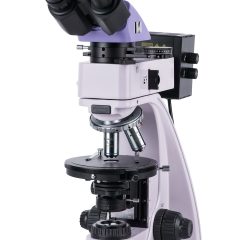
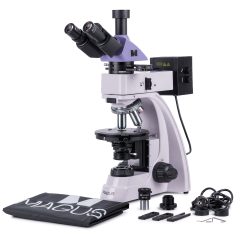
The MAGUS Pol 850 Polarizing Microscope is designed to work in transmitted and reflected light. Available research methods: polarization and brightfield. The microscope is used to study anisotropic biological, geological, and polymer objects as well as opaque polished sections up to 15mm thick with one polished side. The microscope is perfect for a wide range of tasks of professionals in the field of medicine, forensics, mineralogy, crystallography, or petrography.
-


11474,06 € Vat excl. calculated based on location
Microscope for scientific research and industrial inspection.
Designed to study objects in polarized and natural light. Installation of optional components will allow the use of the darkfield and phase contrast methods in transmitted light as well as darkfield, differential interference contrast, and reflected light fluorescence.
In the transmitted light, you can study geological specimens as well as anisotropic biological and polymeric specimens in thin sections.
In the reflected light – polished sections with one polished side. The thickness of the polished sections is arbitrary, usually 5–10mm. The microscope allows you to examine opaque objects up to 30mm thick.
A polarizing microscope uses the birefringence of anisotropic samples to deliver an image. Plane-polarized light, when passing through an anisotropic sample, splits into two rays, and changes the plane of polarization. The analyzer brings the oscillations of the beams into a single plane, which is where they interfere. The bright, high-contrast image changes color when the stage rotates.
The plan semi-apochromatic and plan apochromatic microscope objectives are free from internal strain. The intermediate tube holds the analyzer and Bertrand lens, and it has a slot for compensators.
The microscope is used in crystallography, petrography, mineralogy, forensics, medicine, and other fields of science.
-


3346,57 € Vat excl. calculated based on location
The MAGUS Pol 800 Polarizing Microscope is used to study anisotropic objects in polarized and ordinary transmitted light. Objects of study can be biological, geological, or polymer. The optics of the microscope are strain-free, i.e., they do not create parasitic refractions. They form a clear, high-contrast and authentic image. The microscope’s functionality is useful in various fields of science: medicine, forensics, mineralogy, petrography, crystallography, etc.
-


3107,53 € Vat excl. calculated based on location
The MAGUS Pol 800 Polarizing Microscope is used to study anisotropic objects in polarized and ordinary transmitted light. Objects of study can be biological, geological, or polymer. The optics of the microscope are strain-free, i.e., they do not create parasitic refractions. They form a clear, high-contrast and authentic image. The microscope’s functionality is useful in various fields of science: medicine, forensics, mineralogy, petrography, crystallography, etc.
-


3824,66 € Vat excl. calculated based on location
The MAGUS Pol 850 Polarizing Microscope is designed to work in transmitted and reflected light. Available research methods: polarization and brightfield. The microscope is used to study anisotropic biological, geological, and polymer objects as well as opaque polished sections up to 15mm thick with one polished side. The microscope is perfect for a wide range of tasks of professionals in the field of medicine, forensics, mineralogy, crystallography, or petrography.
-


3665,30 € Vat excl. calculated based on location
The MAGUS Pol 850 Polarizing Microscope is designed to work in transmitted and reflected light. Available research methods: polarization and brightfield. The microscope is used to study anisotropic biological, geological, and polymer objects as well as opaque polished sections up to 15mm thick with one polished side. The microscope is perfect for a wide range of tasks of professionals in the field of medicine, forensics, mineralogy, crystallography, or petrography.
-


422,27 € Vat excl. calculated based on location
A stereomicroscope is an indispensable tool for the detailed study of volumetric samples. It reproduces the virtual volume of an object and allows you to examine its structure, thereby providing a clear image of its topography. The device is equipped with transmitted and reflected light illuminators and allows you to work with both transparent and opaque samples. Polarized light and darkfield methods are optionally available.
The advantages of the Greenough optical design are the large depth of field and three-dimensionality of the image due to the stereoscopic angle of 15°. A stereomicroscope magnifies an object and accurately conveys its position in space: the image is formed uninverted. This makes the microscope an ideal tool for manipulating objects within a working area of 105 to 177 millimeters. Stereomicroscopes are widely used for quality control in restoration, assembly, soldering, jewelry work, and similar processes.
-


446,18 € Vat excl. calculated based on location
The stereomicroscope is designed for studying three-dimensional objects and their structure. The microscope is equipped with built-in transmitted and reflected light illuminators for observing transparent and opaque specimens. Polarized light and darkfield techniques are available.
The Greenough optical design provides a large depth of field and delivers three-dimensional image thanks to a 15° stereo angle. The microscope magnifies the image of the specimen without loss of spatial orientation. Observing specimens placed on the 105–177mm stage is convenient, and so the microscope is suitable for restoration, soldering, assembly, quality control, and other similar operations.
-


478,05 € Vat excl. calculated based on location
MAGUS Stereo 8B is a binocular stereomicroscope with a rotating head. With its help, you can work on three-dimensional samples: The microscope forms a three-dimensional image with a high depth of field and transmits an authentic image of the object. This makes it convenient to carry out the necessary manipulations on the object. The Greenough microscope with independent optical channels has a 15° stereoscopic angle, and its working area ranges from 105mm (basic configuration) to 177mm (optional). The basic methods of working on the device in transmitted and reflected light (brightfield) can be supplemented by the darkfield method and simple polarization with accessories.
-


904,34 € Vat excl. calculated based on location
The ready-made solution for soldering, repair, and quality control is based on MAGUS Stereo 8H series microscope head and universal MAGUS UT2 microscope stand.
The stereomicroscope with the Greenough optical design provides accurate details of the surface topography with no loss of spatial orientation, thereby ensuring a large depth of field. The binocular microscope is suitable for those who prefer to operate the microscope in their normal posture and view the specimen through the eyepieces.
The microscope is equipped with two reflected light illuminators: ring light with a polarization filter and a gooseneck light.
The microscope optimizes workplace ergonomics, thus improving operator comfort and productivity.
