Standard AC/DC adapter to be used with ASI-cooled cameras and ASIAIR Plus (and PRo).
The handy adapter supplies constant 12-volt power at 5A.
European standard
Can be used in France, Itatly, the Netherlands, Denmark, Finland, Norway, Poland, Portugal, Austria, Belgium, Hungary, Spain, Sweden , South Korea, Russia etc.
ZWO ASI071MC Pro features a Sony IMX071 APS-C sized sensor and is highly recommended for deep sky astrophotography. The ASI071MC Pro offers very good performance for astrophotography. Low read noise, high dynamic range.
The camera includes a 256MB DDR3 memory buffer to help improve data transfer reliability. Additionally, the use of a memory buffer minimizes amp-glow, which is caused by the slow transfer speeds when the camera is used with a USB 2.0 port.
The ASI071MC Pro has a two-stage TEC cooling system that allows deep cooling (35°C-40°C below ambient). You will need an external power supply to power the cooler.
The ZWO ASI 120 Series cameras are a very popular choice for many amateur astronomers. The cheap price and high built-quality have made these cameras the number one recommendation for people looking for a camera for autoguiding or planetary imaging.
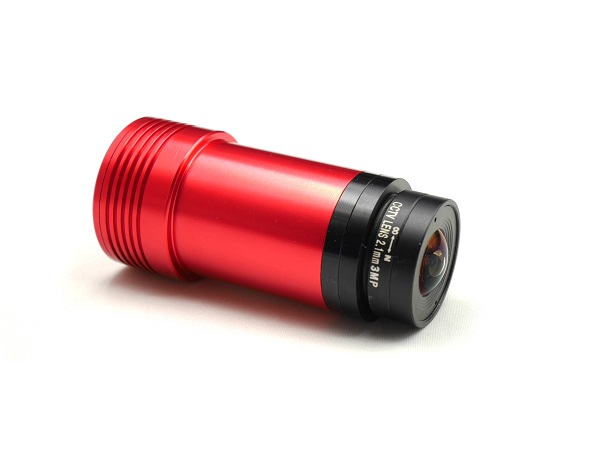
The 120MM-S and MC-S come with a wide-angle lens, making them a great all-sky camera. The 120MM Mini is great for autoguiding due to its small and handy size.
There are 3 different models available:
ZWO ASI 120MM Mini = MONO autoguiding/planetary imaging camera (USB 2.0, USB-C connection)
ZWO ASI 120MM-S = MONO autoguiding/planetary imaging camera (USB 3.0)
ZWO ASI 120MC-S = COLOR autoguiding/planetary imaging camera (USB 3.0)
ZWO ASI 1600MM Pro is a very popular deep sky astrophotography camera with a 4/3″ sensor.
The ASI1600MM Pro offers very good performance for astrophotography. It has a low read noise, a low dark current and a high dynamic range. The ASI1600 Pro has a 2 stage TEC cooling system to enable very deep cooling (40°C-45°C below ambient). The cooler requires an external power supply, which is not included with the camera. The camera includes a 256MB DDR3 memory buffer to help improve data transfer reliability. Additionally, the use of a memory buffer minimizes amp-glow, which is caused by the slow transfer speeds when the camera is used with a USB 2.0 port.
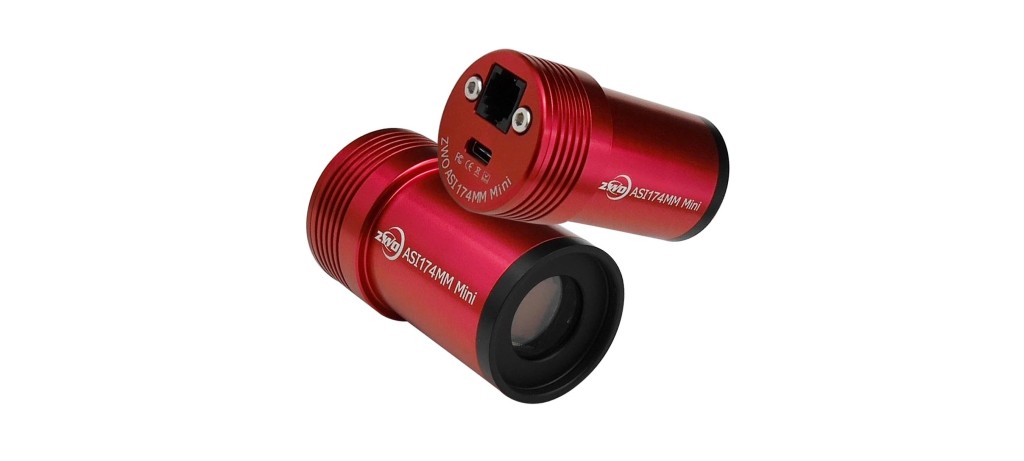
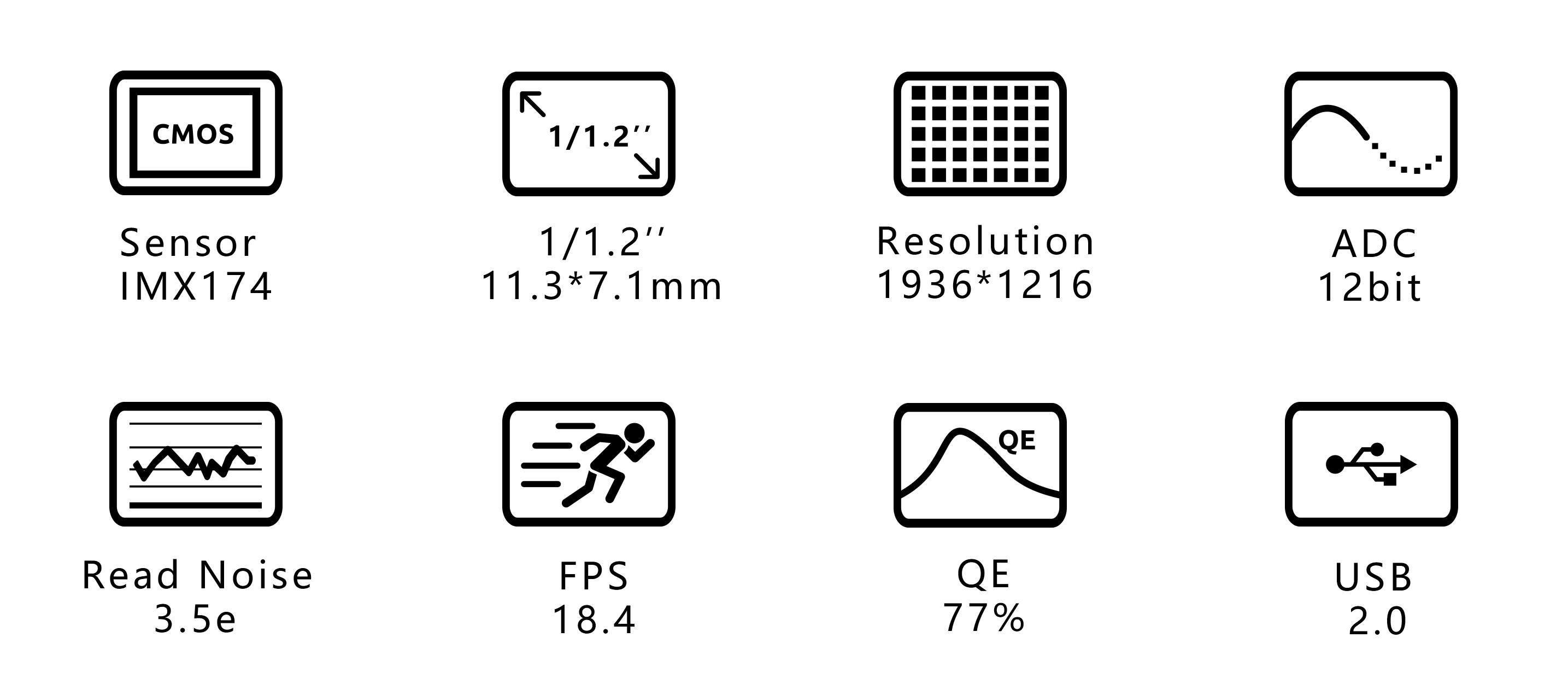
ASI174MM Mini camera integrates Sony IMX174LLJ / IMX174LQJ 1/1.2″ sensor (11.3 mm x 7.1 mm). It is the first model in the “mini”-series of cameras from ZWO. This camera has 1936 x 1216 pixels with a pixel size of 5.86 μm x 5.86 μm. It camera provides 12-bit ADC and its QE peak is 77%.
Astrophotography Performance
ASI174MM mini camera offers you very good performance for planetary imaging as well as for guiding. Low read noise, high dynamic range, AR protective window and much more are just some of the key characteristics that set it apart from the competition.
High QE
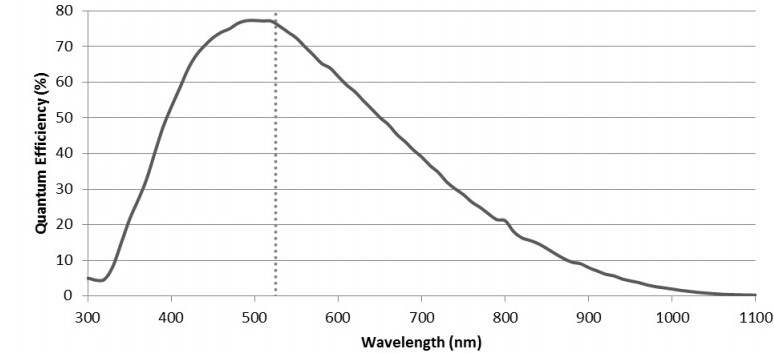
Regarding the absolute QE Curve, we estimate the Peak Value is about 77%.
174Mini vs. 174MM
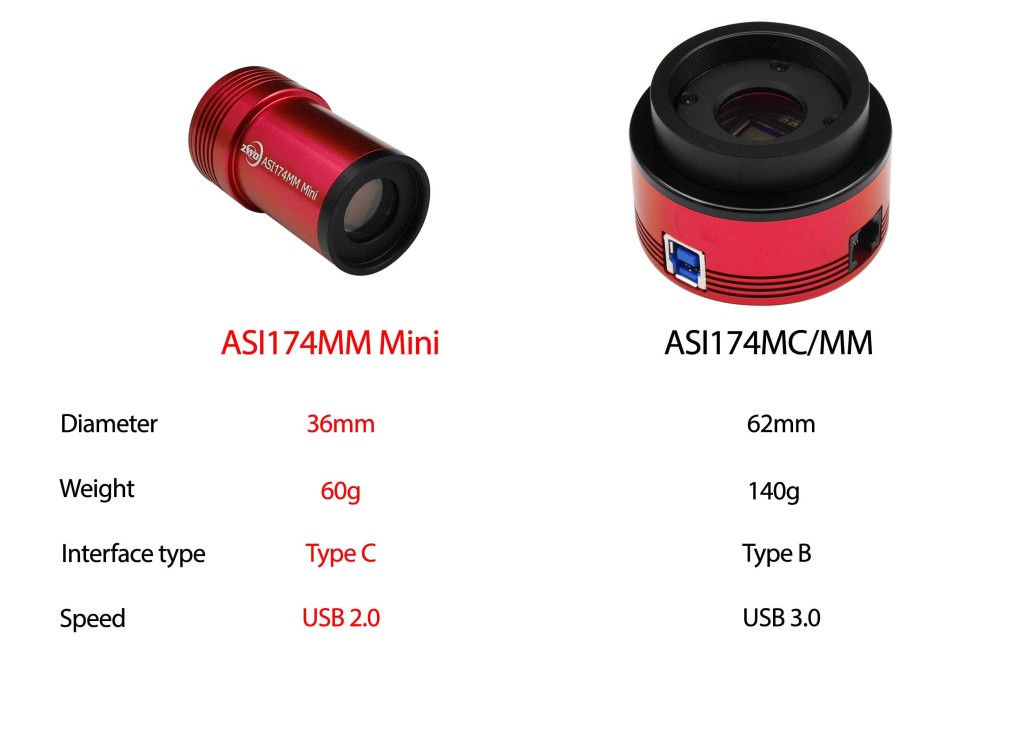
Compared with the ASI174MM camera, the new 174-Mini has a sleeker design, less weight, and it can reach focus at the same position as an eyepiece.
USB2.0Port & ST4 Port
USB 2.0 Port: Mini camera has one USB2.0 type-C port. Type-C port is very popular in mobile phones, as it doesn’t matter which way you connect it (unlike for example type-A or type-B)
#USB-C to USB-A cable is required.
ST4 Port: The camera can be connected directly to the auto-guider port of the mount.
Connecting Drawing
M28.5-CS adapter
CS-C adapter
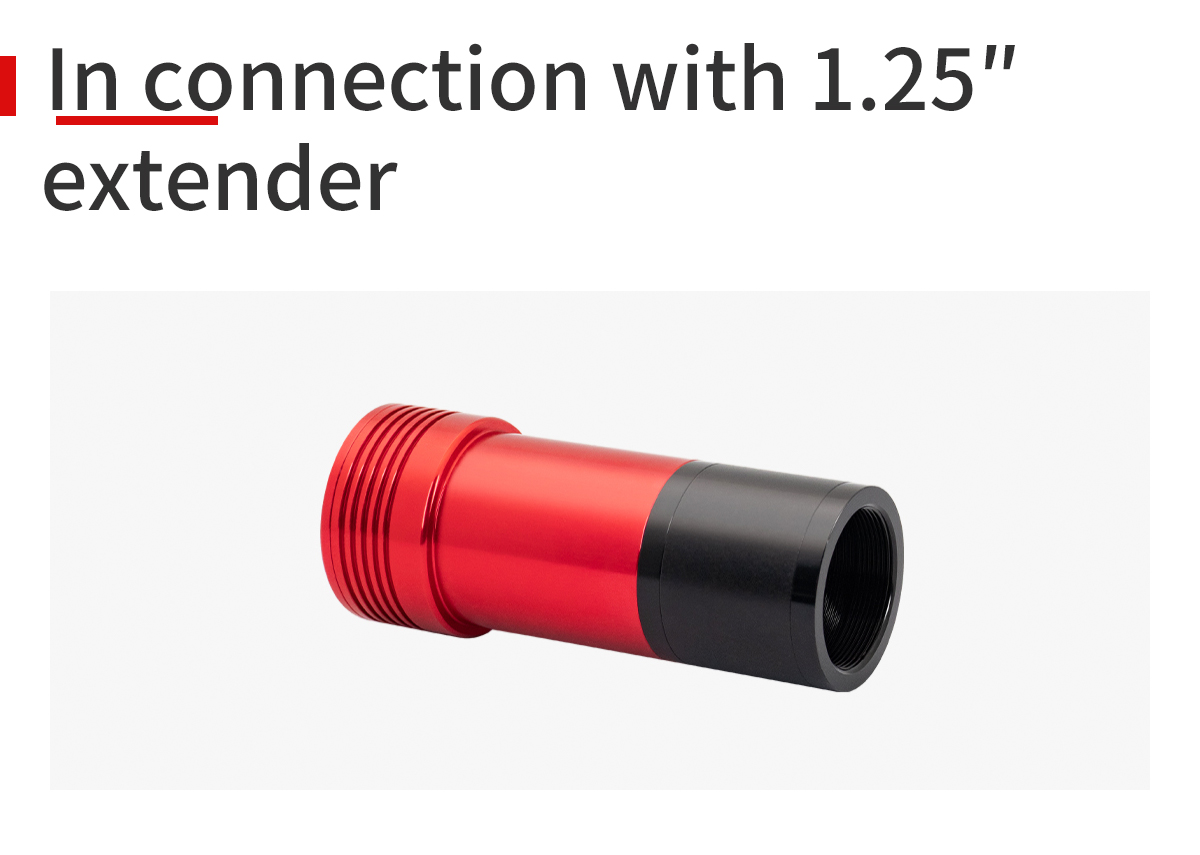
1.25″ extender
1.25″ filter
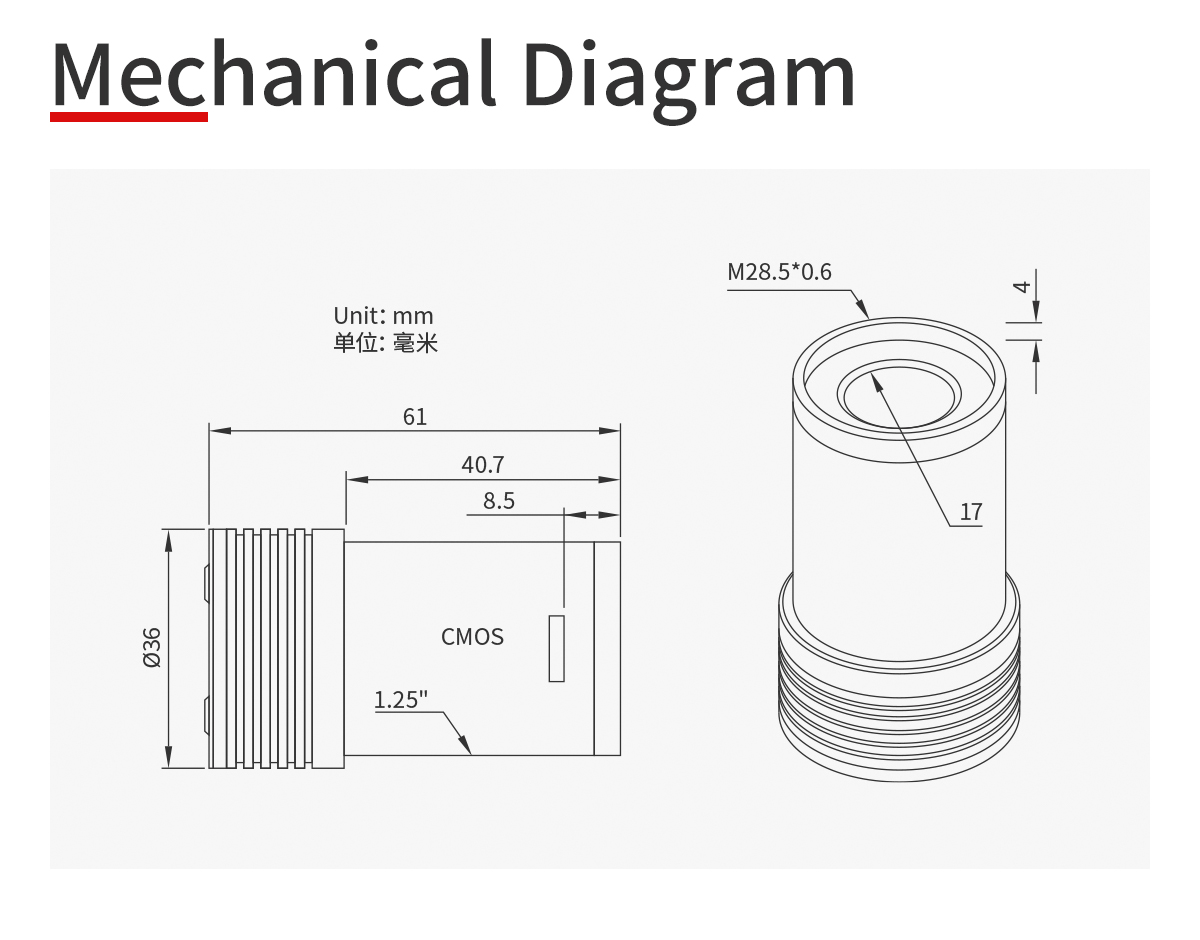
Mechanical Drawing
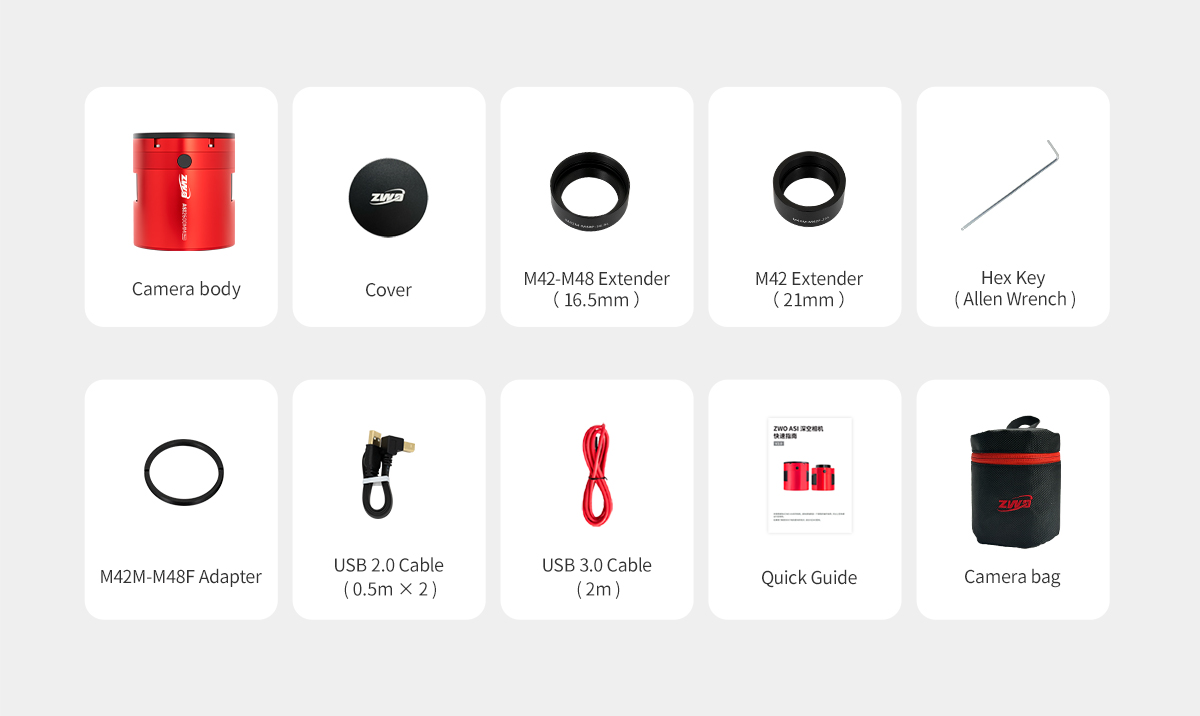
What is in the box?
ASI mini camera box includes all necessary cables, adapters, and manual.
Drivers and Softwares:
Our website is always updated with the most recent camera drivers as well as software for DSO and planetary imaging. Please make sure the most recent driver and software has been installed before you start shooting:
ASI120, ASI174 and ASI290 mini camera have very beautiful outlooks, small size, lighter weight, this is not a big deal.
We should consider much more…
How to choose a good guide camera?
Many people might mention the size, ability to fit with different types of equipment (guide scopes, OAG etc.), stability and ease-of-use.
We agree. That is why our cameras in the “mini”-series all fulfill these, what we think are, basic characteristics of a good guide camera.
But what are truly the most important traits. Let’s face it, when you set up your equipment for a night of imaging, you just want things to work and to see that smooth graph on your guiding software before you start your imaging sequence. In order to do that, there are some things to consider (apart from the points mentioned above):
Sensitivity,
Precise guiding,
Big FOV.
High Sensitivity
Sensitivity is the first thing we considered. This is of course a crucial ability when looking for a star to guide on. So, from the beginning, we were set on using monochrome sensors to design our guide cameras. Because monochrome sensors have much higher sensitivity than their colour counterpart. Luckily the ASI120MM Mini, ASI290MM Mini and ASI174MM Mini all have very high QE peak value – about 80%, which can detect more stars in view and shorten the exposure time in guiding.
Each of the cameras have their own strength and depending on what you value in a guide camera, one might be better for you than the others.
Entry Level
ASI120MM Mini is designed for newcomers, it is more affordable than ASI290MM Mini and ASI174MM Mini. You can easily get the well-sampled stars with the help of ASI120MM Mini. It’s light, compact and robust. If you are still wondering about which one you should choose as your first guide camera, the ASI120MM Mini is a very good choice.
Precisely Guiding
ASI290MM Mini is designed for precise guiding. The 2.9um pixel size gives you a higher arcsec/pixel than the ASI224 or ASI120 camera. This means that, in the same guide scope, the ASI290MM Mini can detect movement of stars to a higher degree than the other cameras. ASI290MM Mini will improve your guiding precision with around 30% compared to the ASI120MM Mini.
Big FOV
ASI174MM Mini is designed for large field-of-view guiding. This is very useful when looking for a star to guide on, using an OAG. When you use an OAG-guider with a Ritchey-Chretien or Schmit-Cassegrain telescope, the hardest part is to find a suitable guide star. ASI174MM Mini has a larger1/1.2″ sensor which means your FoV is 4 times than that of the ASI120MM Mini.
Smiling Face
If you squint your eyes, the back of the ASI mini-camera looks like a smiling face (albeit you have to squint quite hard). On the back you will find a type-C USB port, which is widely used in mobile phones. The ST4-port is used for auto-guiding on mounts. So if you are having one of those observing nights when Murphy’s law is by your side, at least you’ll have an excellent guide camera (that smiles at you).
Focus like a eyepiece
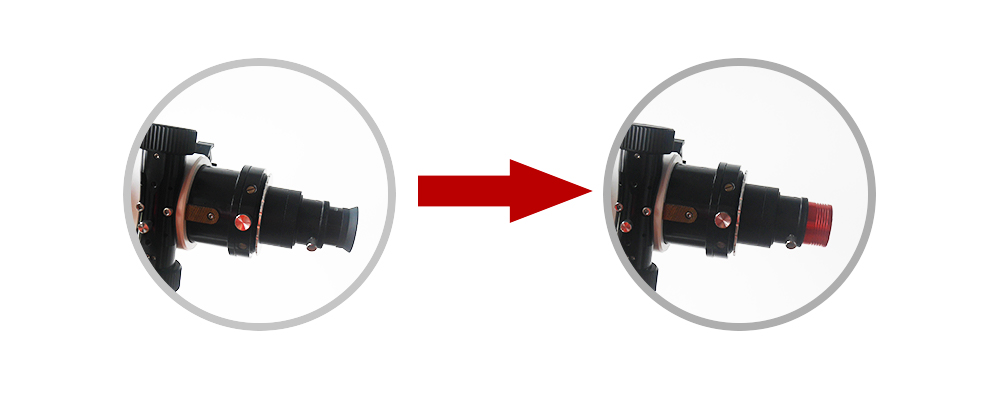
ASI mini camera can focus at the same position as an eyepiece. This means that you can focus with an eyepiece, and then directly insert the ASI mini camera into 1.25″ holder – focus done!
Work with OAG
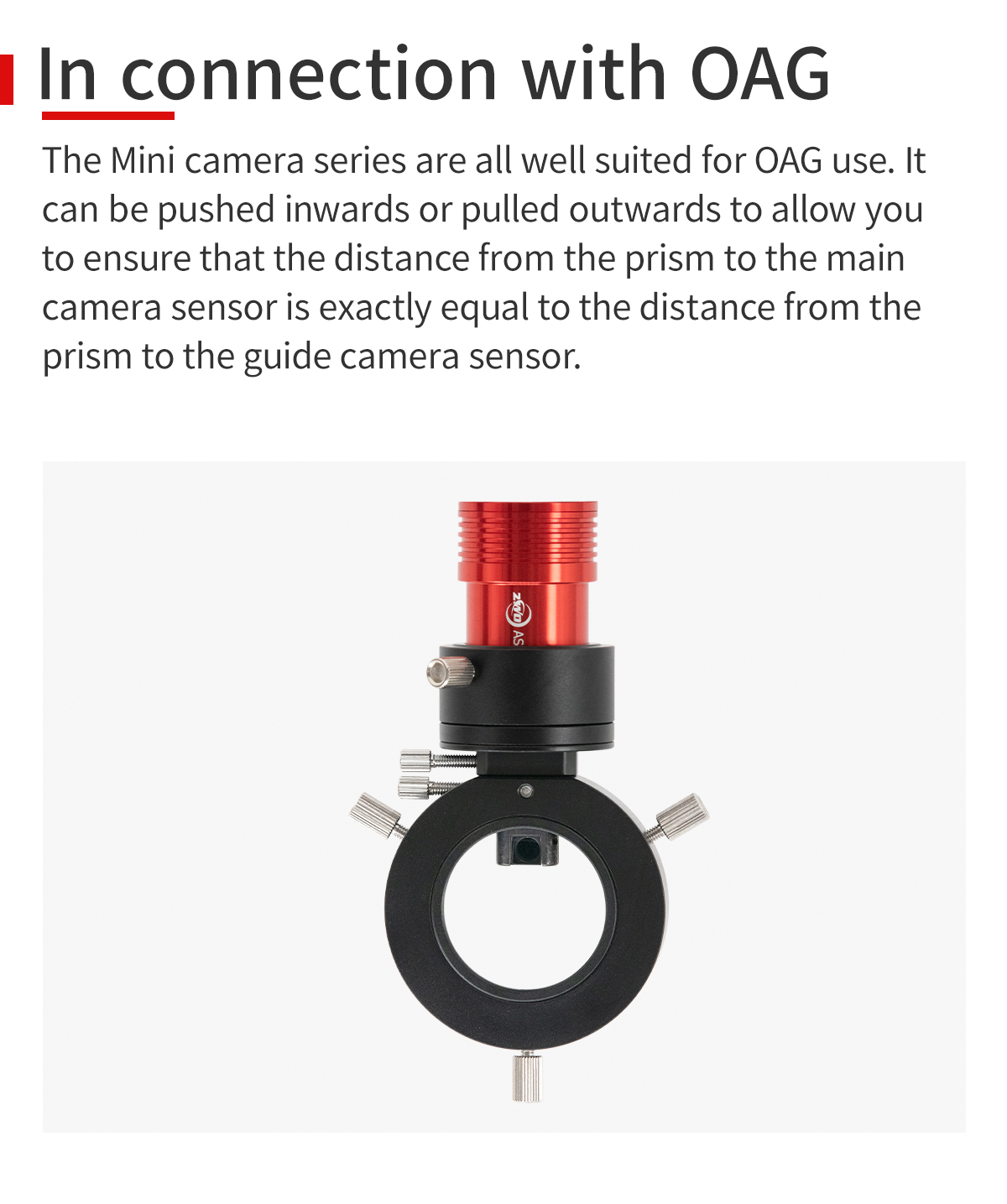
The Mini-camera series are well suited for OAG use: They have a much bigger focus range than normal ASI cameras. No more worrying about your guide camera and main camera not being able to find focus at the same time.
ZWO ASI 178MC features a 6.4 megapixel 1/1.8″ Sony IMX178 sensor with 2,4 μm pixel size and 3096 * 2080 resolution. We highly recommend these cameras for planetary and lunar astrophotography, as well as autoguiding. With the included all sky lens, these cameras also make a fantastic all sky camera.
There are two versions of this camera:
ZWO ASI 178MM = Mono lunar/planetary camera without cooling.
ZWO ASI 178MC = Color lunar/planetary camera without cooling.
ZWO ASI 178MM features a 6.4 megapixel 1/1.8″ Sony IMX178 sensor with 2,4 μm pixel size and 3096 * 2080 resolution. We highly recommend these cameras for planetary and lunar astrophotography, as well as autoguiding. With the included all sky lens, these cameras also make a fantastic all sky camera.
There are two versions of this camera:
ZWO ASI 178MM = Mono lunar/planetary camera without cooling.
ZWO ASI 178MC = Color lunar/planetary camera without cooling.
The ZWO ASI 183 series features a 1″ Sony IMX 183 sensor, available in both monochrome and color. There a 4 different versions of this camera available. For deep sky imaging, we recommend getting a cooled “Pro” version. For lunar and planetary imaging, the non-cooled version is sufficient.
ASI 183MM Pro = Mono deep sky camera with cooling.
ASI 183MC Pro = Color deep sky camera with cooling.
ASI 183MM = Mono lunar/planetary camera without cooling.
ASI 183MC = Color lunar/planetary camera without cooling.
The ZWO ASI 183 series features a 1″ Sony IMX 183 sensor, available in both monochrome and color. There a 4 different versions of this camera available. For deep sky imaging, we recommend getting a cooled “Pro” version. For lunar and planetary imaging, the non-cooled version is sufficient.
ASI 183MM Pro = Mono deep sky camera with cooling.
ASI 183MC Pro = Color deep sky camera with cooling.
ASI 183MM = Mono lunar/planetary camera without cooling.
ASI 183MC = Color lunar/planetary camera without cooling.
The ZWO ASI 183 series features a 1″ Sony IMX 183 sensor, available in both monochrome and color. There a 4 different versions of this camera available. For deep sky imaging, we recommend getting a cooled “Pro” version. For lunar and planetary imaging, the non-cooled version is sufficient.
ASI 183MM Pro = Mono deep sky camera with cooling.
ASI 183MC Pro = Color deep sky camera with cooling.
ASI 183MM = Mono lunar/planetary camera without cooling.
ASI 183MC = Color lunar/planetary camera without cooling.
The ZWO ASI 183 series features a 1″ Sony IMX 183 sensor, available in both monochrome and color. There a 4 different versions of this camera available. For deep sky imaging, we recommend getting a cooled “Pro” version. For lunar and planetary imaging, the non-cooled version is sufficient.
ASI 183MM Pro = Mono deep sky camera with cooling.
ASI 183MC Pro = Color deep sky camera with cooling.
ASI 183MM = Mono lunar/planetary camera without cooling.
ASI 183MC = Color lunar/planetary camera without cooling.
ZWO ASI224MC features a Sony IMX224 color sensor and is highly recommended for planetary astrophotography. ASI224MC offers very good performance for astrophotography. Low read noise, high dynamic range, QE peak >80%, AR protective window and much more.
The ZWO ASI2400MC Pro uses Sony’s latest back-illuminated IMX410 full frame format 14-bit ADC sensor. It is a 24MP camera with a big pixel size of 5.94um that can accommodate a super large well depth of 100ke.
The ASI2400MC Pro sensor length and width are 36mm * 24mm and the diagonal is 43.3mm. The camera comes with a anti-dew heater which completely fits the protective window and will heat it to avoid any dew problems. The anti-dew heater power requirement is around 5W and the heater can be turned off in software to save power.
The camera uses two stage TEC cooling that can lower the CMOS sensor temperature to more that 35c below ambient, which can greatly reduce dark current generation and sensor noise even with extended exposure times.
The unique dark current suppression technology can even further reduce dark current noise. When it’s cooled to -20℃, the current noise can be as low as 0.00035e/s/pix, which is completely negligible!
As the ASI2400MC Pro uses zero amp glow circuitry, you won’t have to worry about amp glow even when using high gain, long exposure imaging.
The ASI2600MC Duo combines imaging and guiding sensors in one camera. The main sensor is APS-C format IMX571 made by Sony. With a native 16-bit ADC, 14 stops dynamic range and a impressive full well capacity of 73ke it is one of the best colour cameras on the market. This versatile camera only needs one USB cable for guiding and imaging, preventing possible cable snags by reducing the amount of cables.
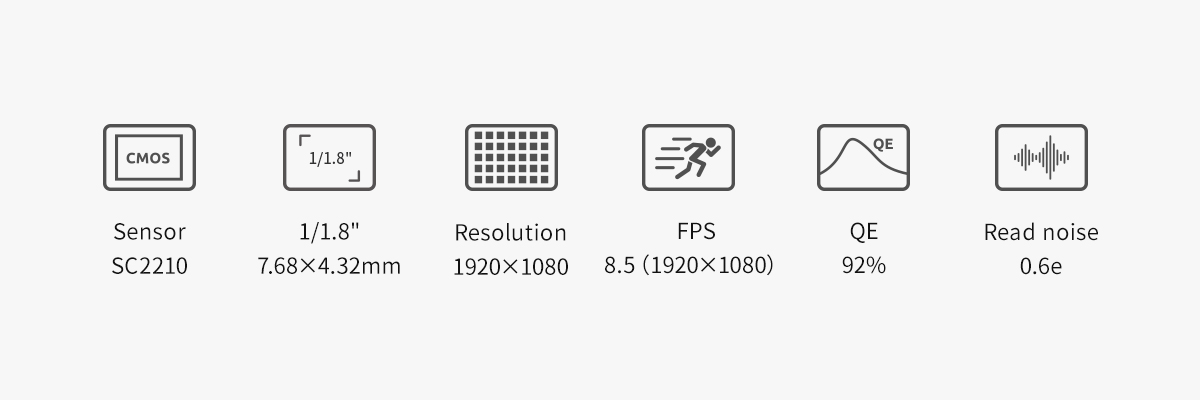
The guide sensor is the Type 1/1.8 SC2210 with excellent NIR sensitivity. The sensor size is 7.68mm x 4.32mm. It has 4umx4um pixels with an array of 1920×1080 and a full depth of 8780e.
The body weighs just 0.7 kg(1.54 lbs), yet delivers outstanding image performance.
APS-C Sony IMX571 Sensor
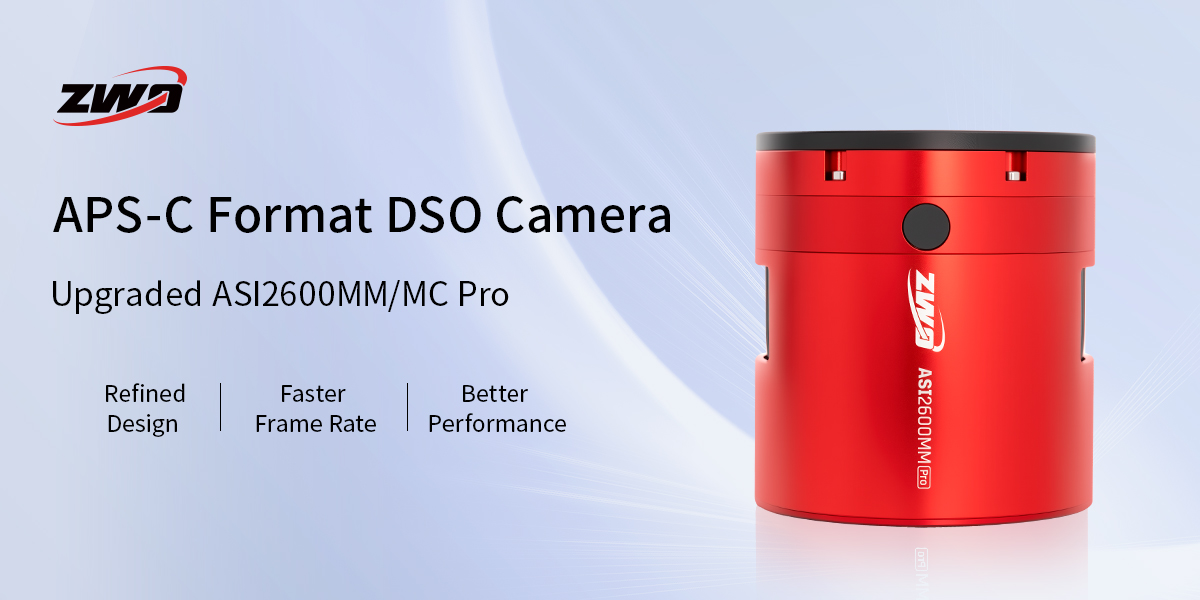
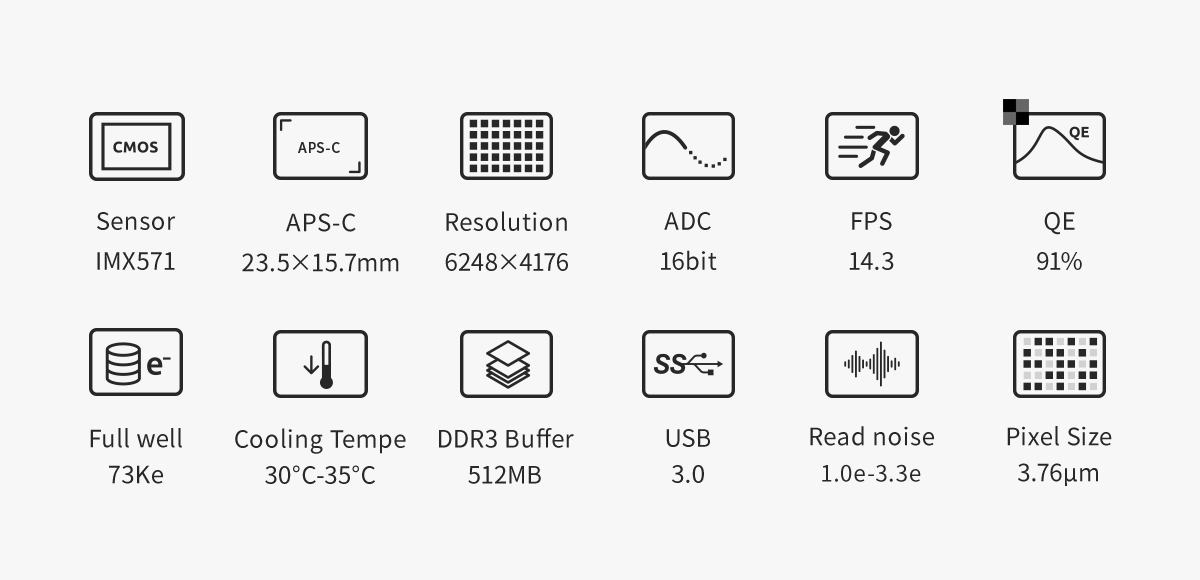
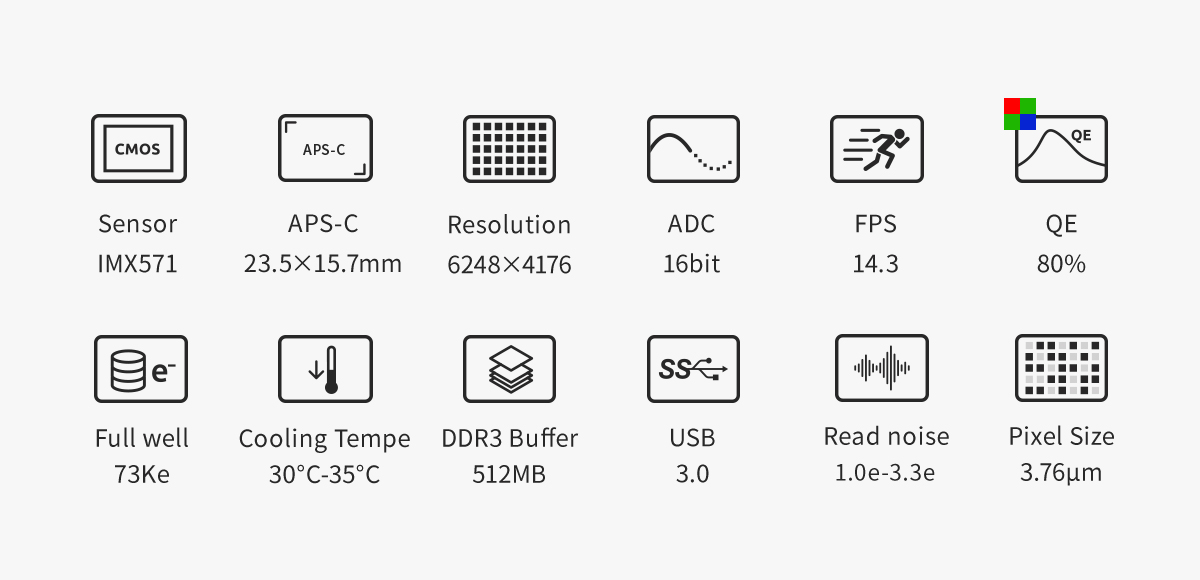
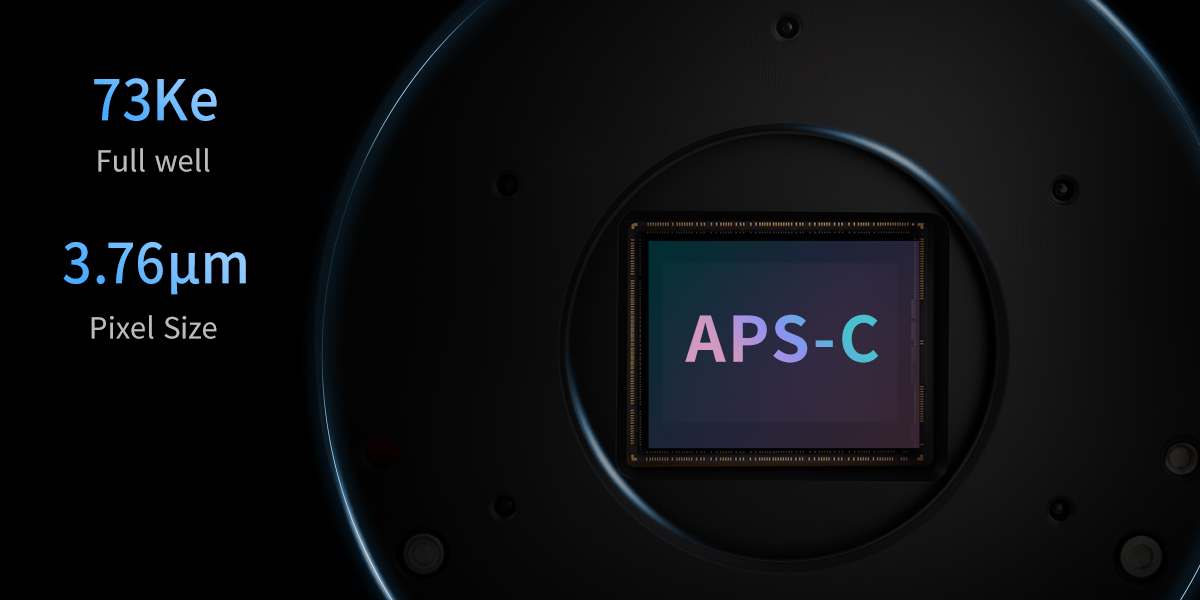
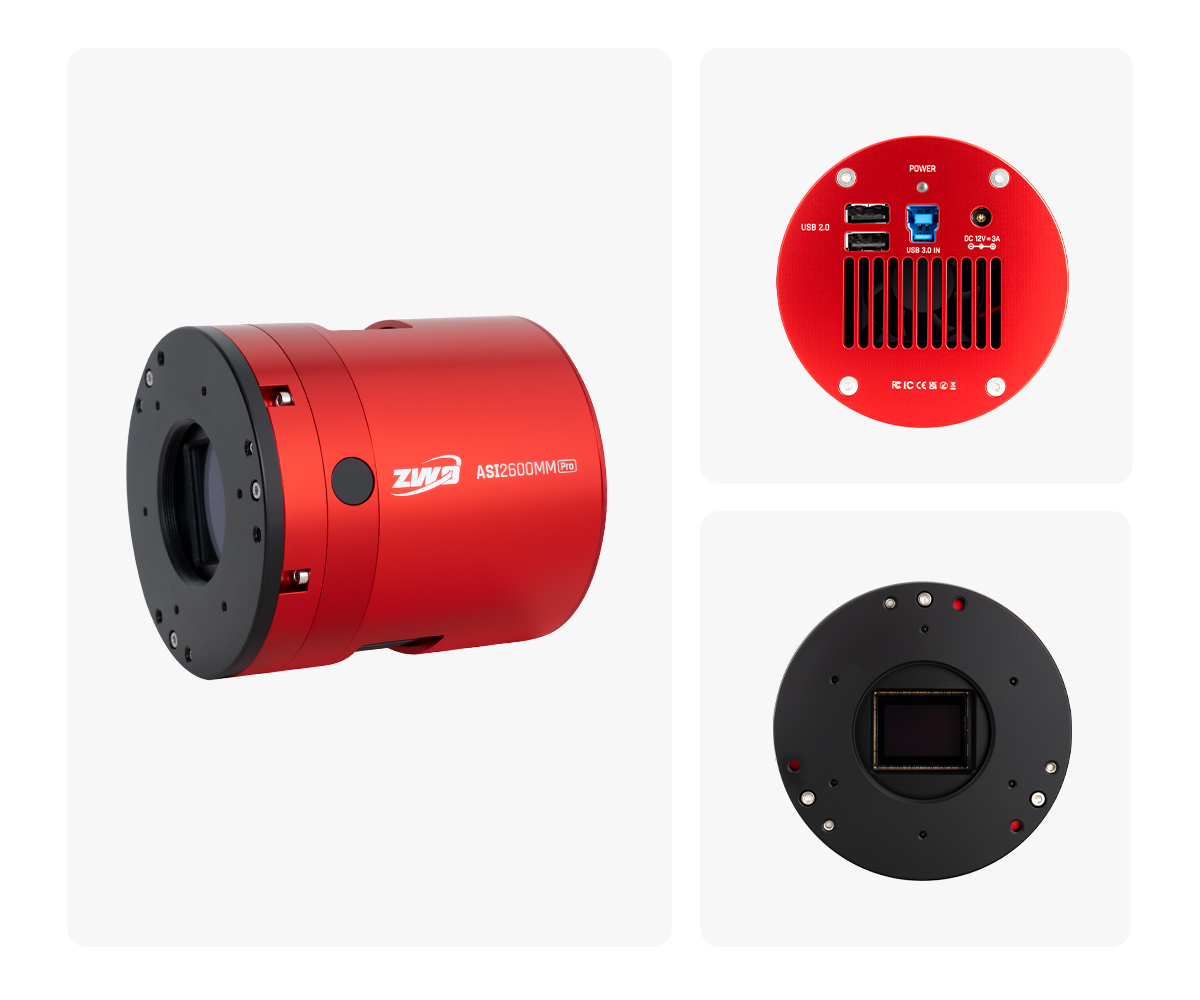
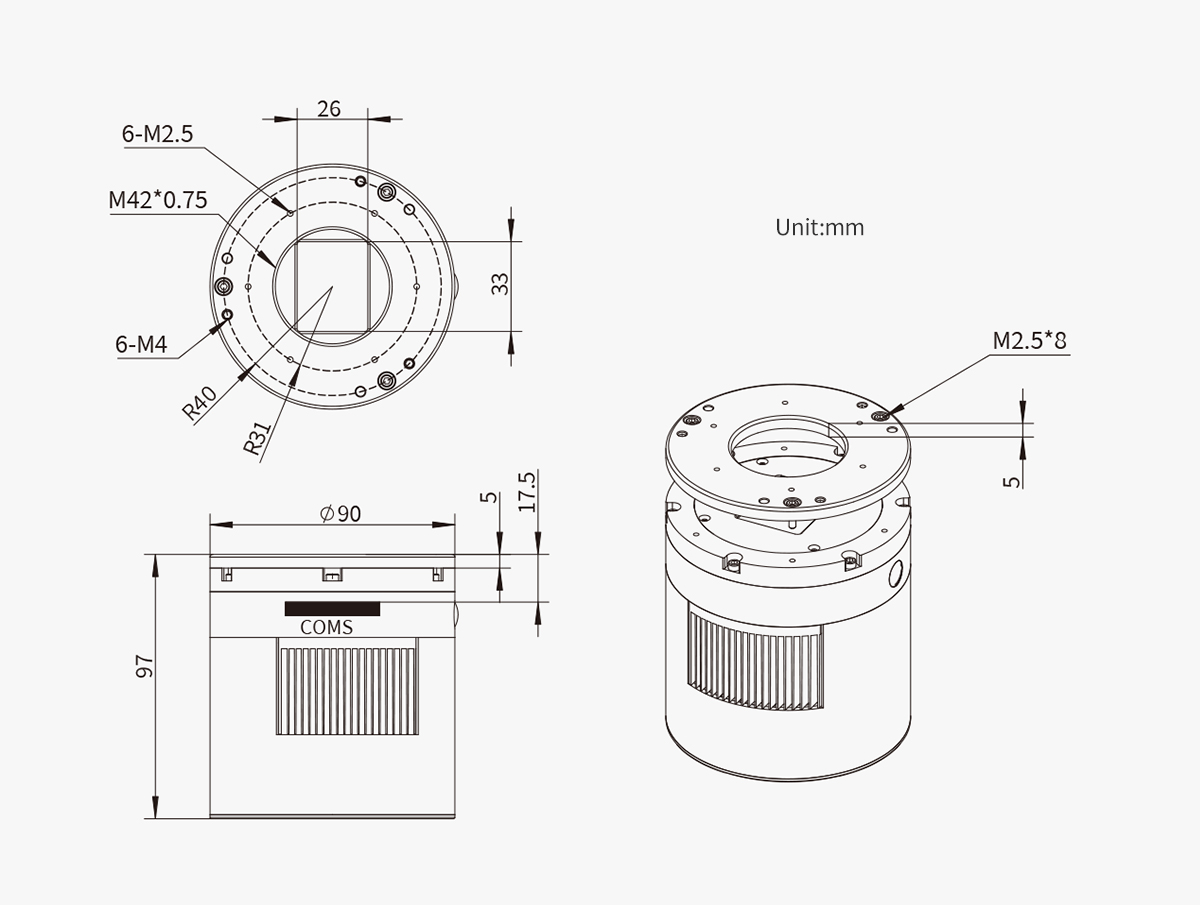
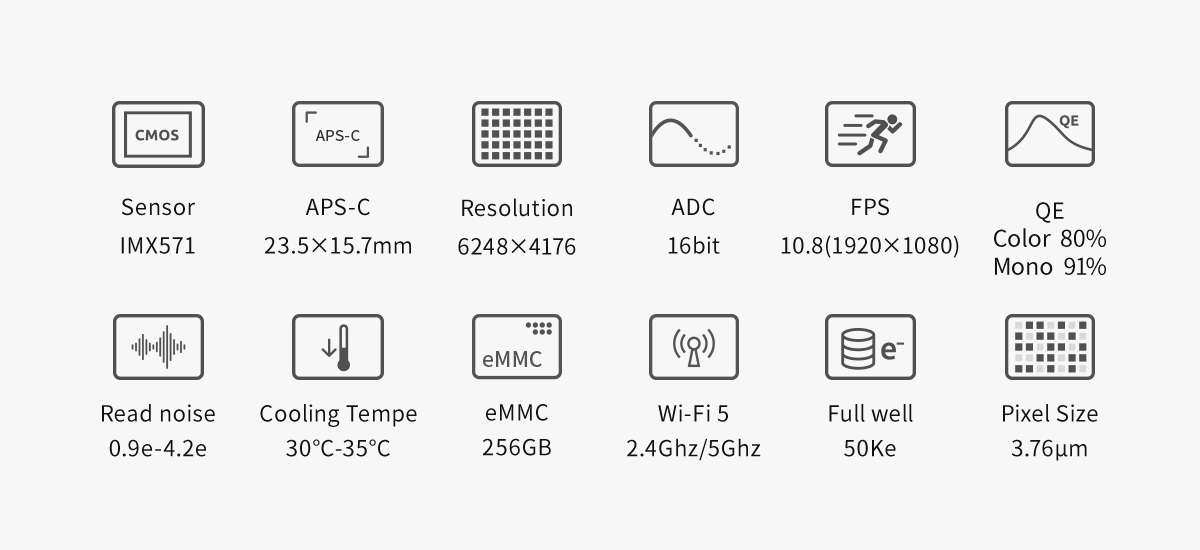
The ASI2600MM/MC Pro is equipped with the APS-C format Sony IMX571 sensor, measuring 23.5mm × 15.7mm with a 28.3mm diagonal. It delivers an outstanding resolution of 6248 × 4176 pixels, making it a true 26-megapixel powerhouse. Each 3.76 μm pixel offers an impressive full-well capacity of 73ke⁻, ensuring exceptional dynamic range and image quality.
Native 16bit ADC
The advanced CMOS architecture of the ASI2600 enables a true 14-stop dynamic range. This ensures exceptionally smooth tonal transitions, richer color gradients, and the ability to capture both the faintest details and the brightest highlights within a single frame.
Zero Amp Glow
As the ASI2600MM/MC Pro uses zero amp glow circuitry, you won’t have to worry about amp glow even when using high gain, long exposure imaging.
Anti-dew
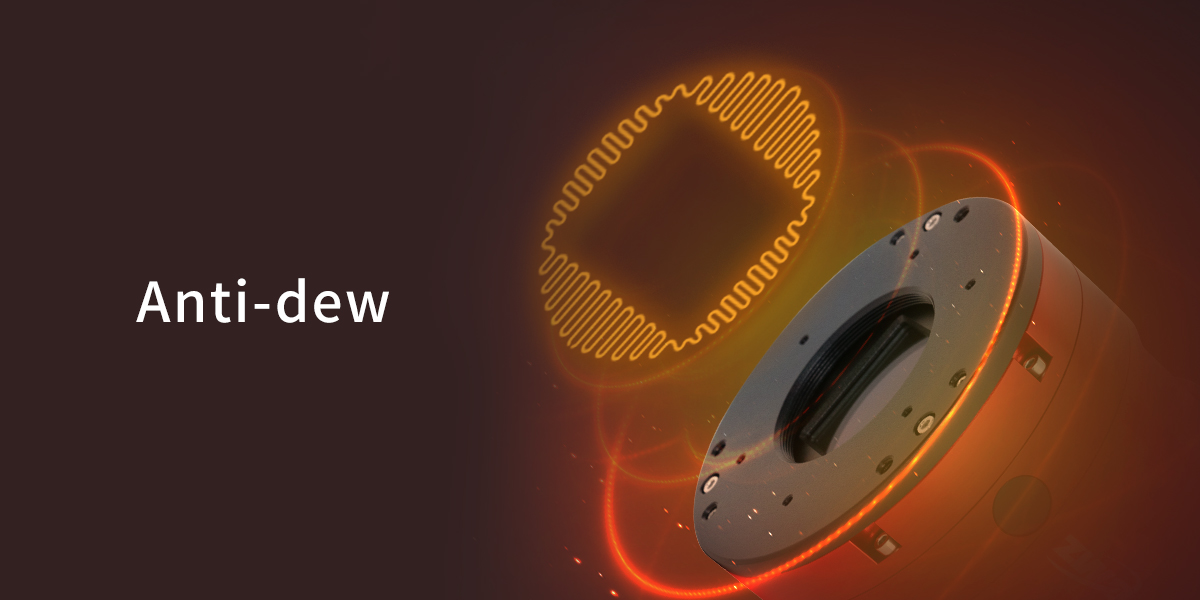
The ASI2600MM/MC uses a built-in polyimide heater bonded to the protective window, preventing dew and frost for clear, reliable imaging all night long.
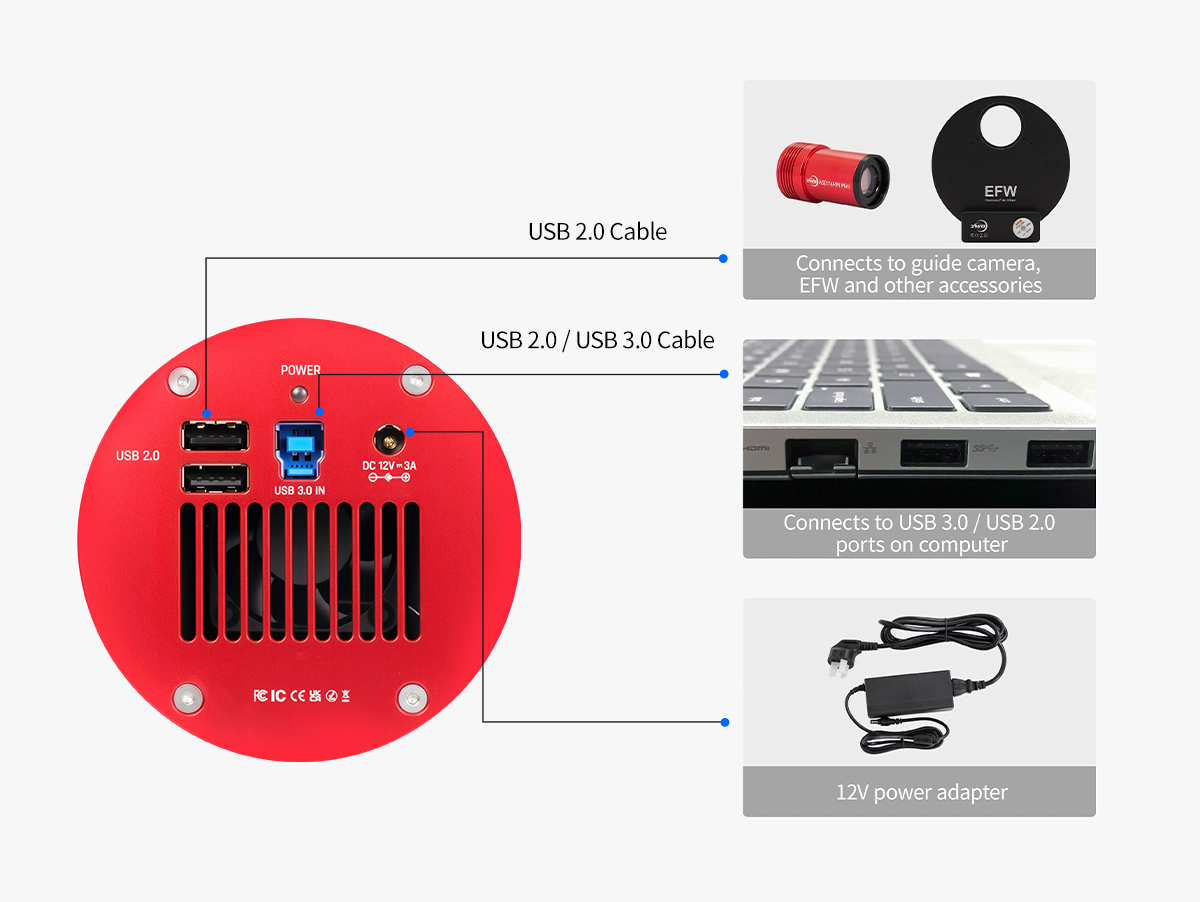
USB 3.0 & 512MB DDR3 Memory
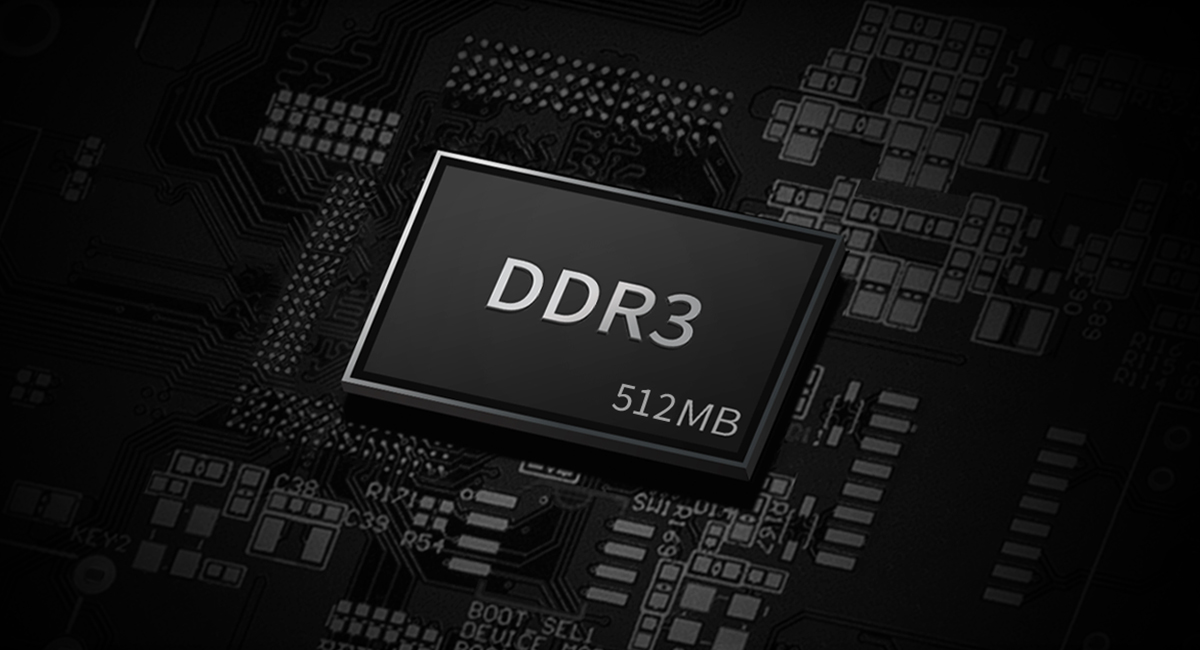
The ASI2600MM/MC Pro incorporates a high-speed USB 3.0 interface paired with a dedicated 512MB DDR3 memory buffer. This architecture minimizes data loss and latency, delivering fast, stable, and secure transmission even during long exposures and continuous high-resolution capture.
Sensor Tilt Adjustment
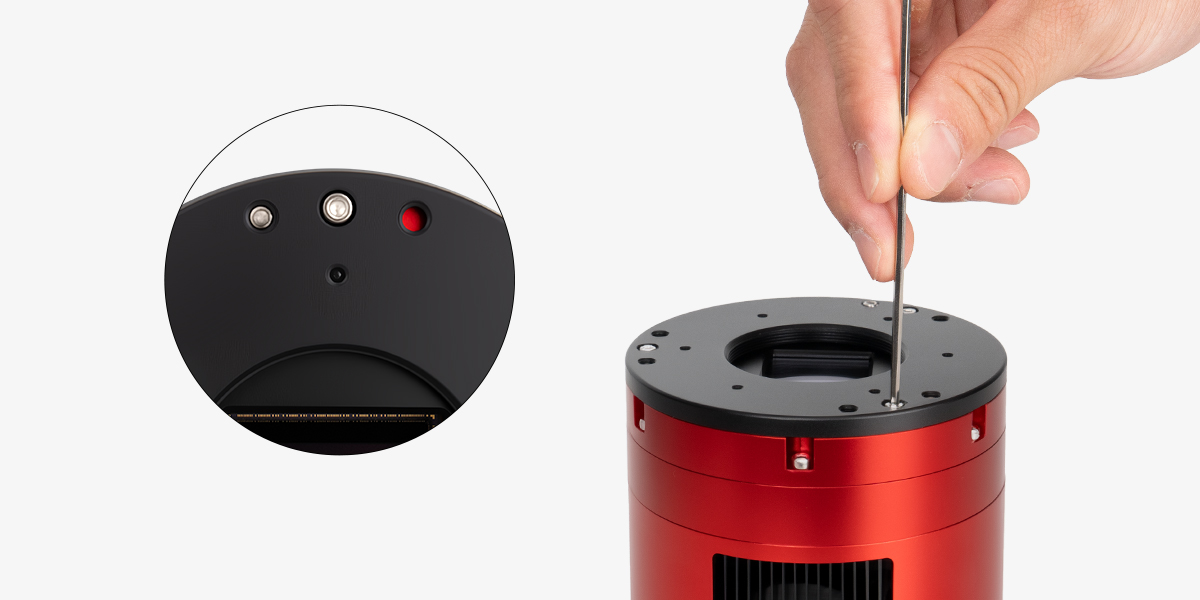
The camera incorporates a tilt plate with three sets of adjustment screws. In combination with the three mounting screws, they enable precise fine-tuning of the sensor plane for accurate alignment with the telescope’s optical axis, ensuring a flat imaging field and consistent star shapes across the entire frame.
Two-stage TEC cooling
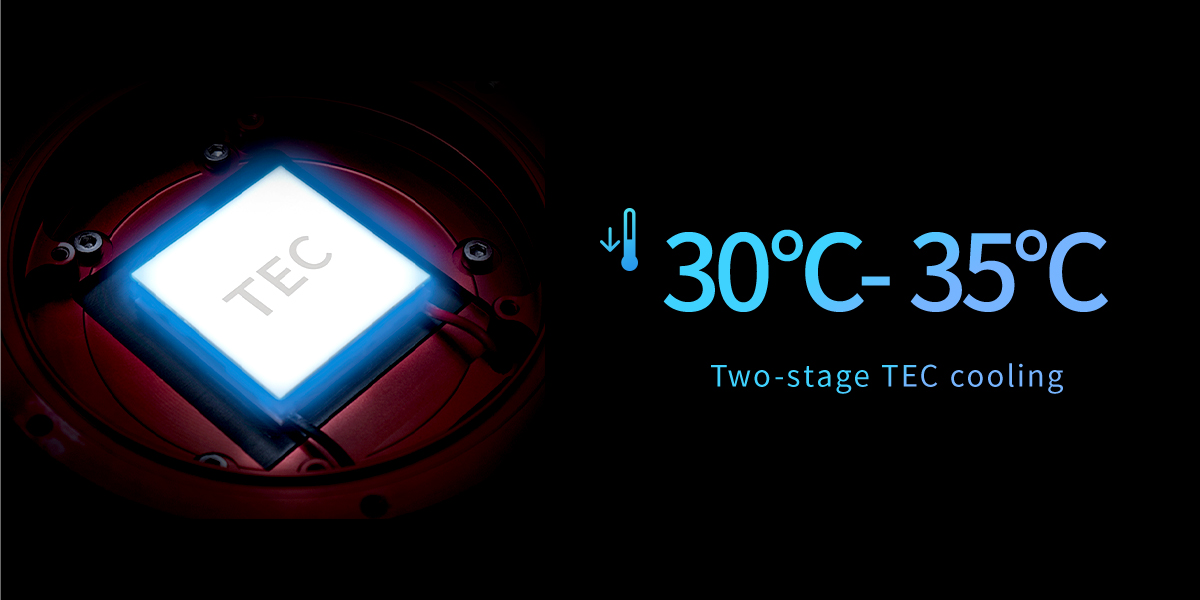
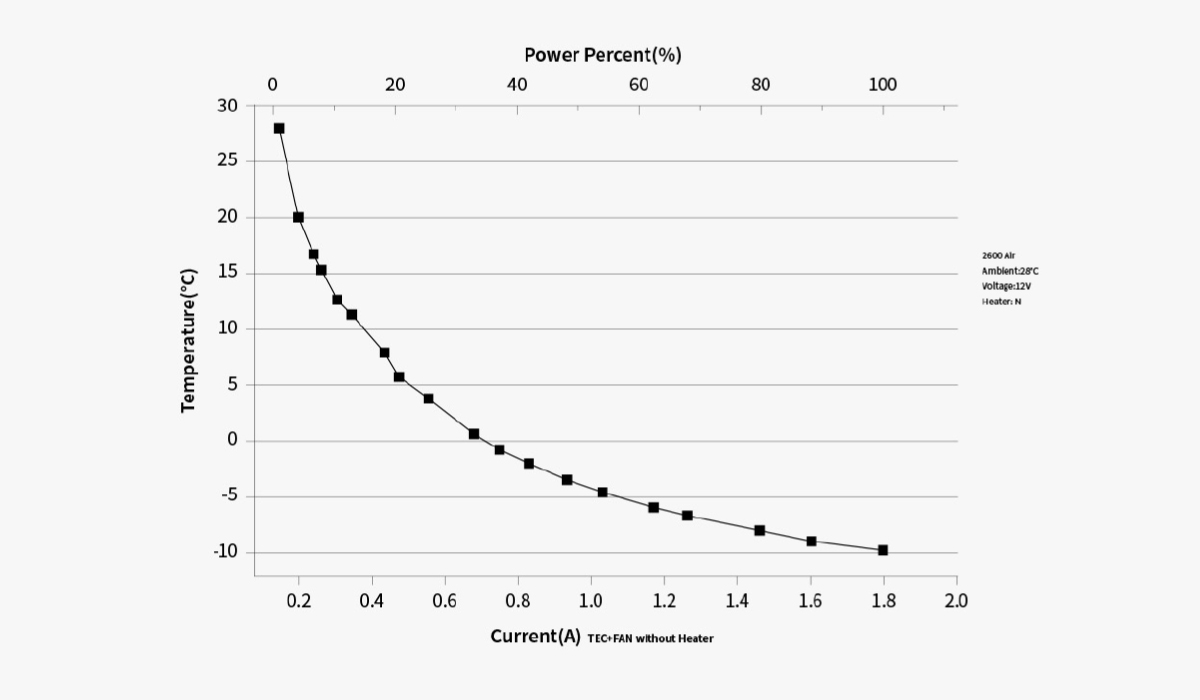
Thanks to its two-stage TEC cooling system, the ASI2600MM/MC Pro can reduce the CMOS sensor temperature by 30°C–35°C below ambient, significantly lowering dark current and sensor noise even during long exposures.
The ΔT of 35°C is measured at 30℃ ambient temperature.
Camera Performance
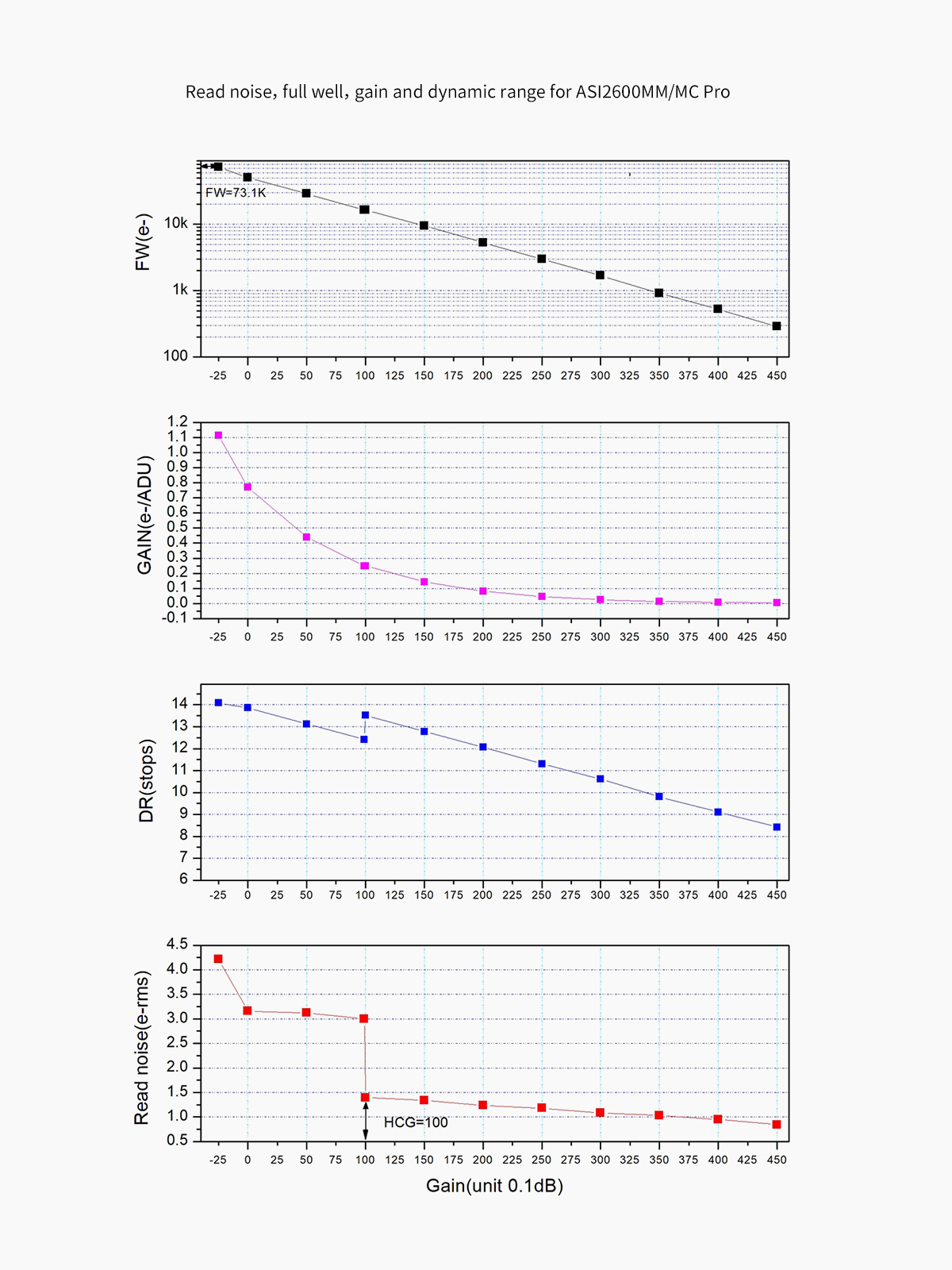
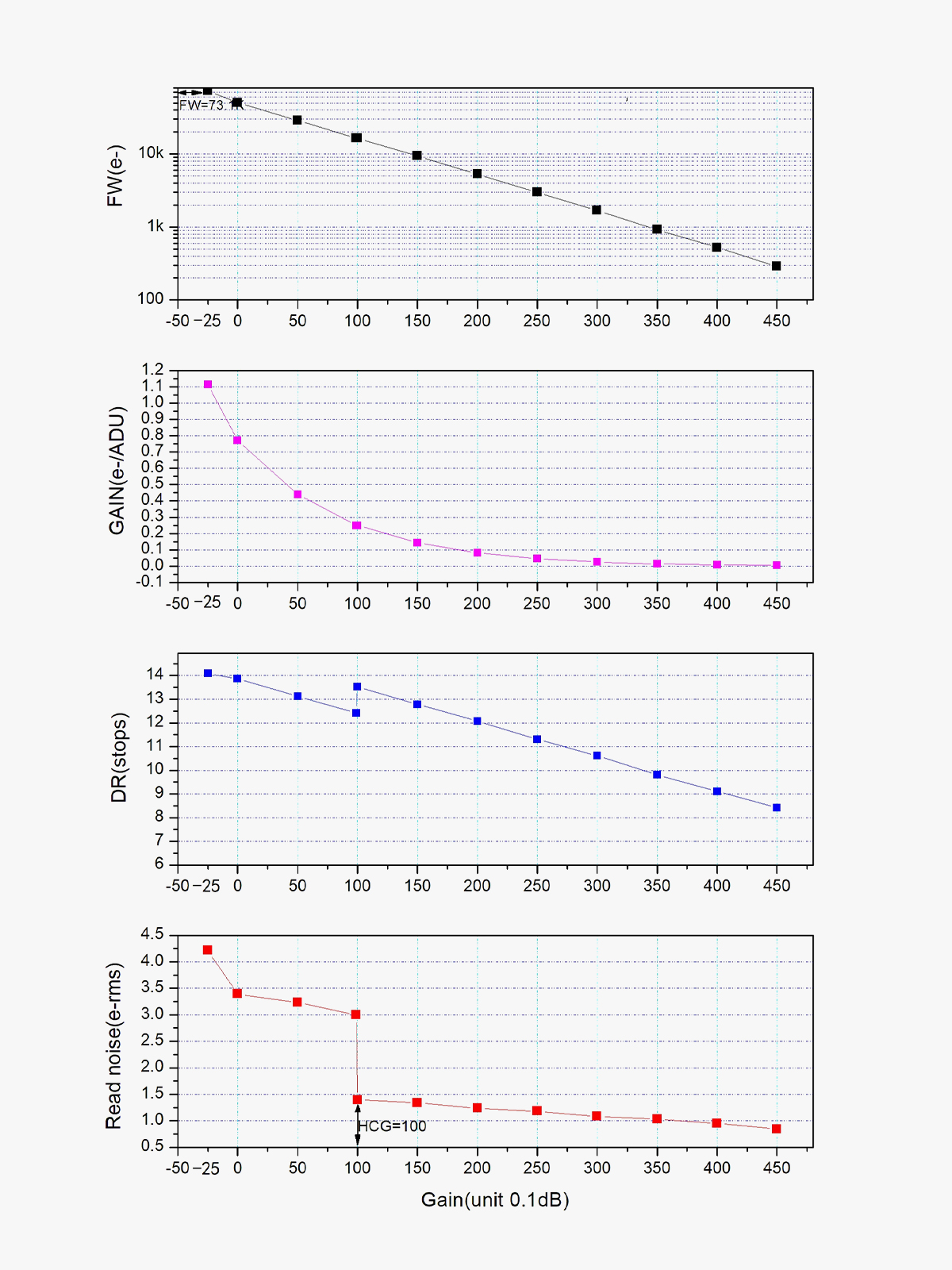
The ASI2600MM/MC Pro achieves a dynamic range of up to 14 stops. When the gain setting reaches 100, the HCG (High Conversion Gain) mode is automatically enabled, which substantially reduces readout noise while preserving dynamic range. For optimal deep-sky imaging performance, a gain setting of 0 or 100 is recommended.
QE value
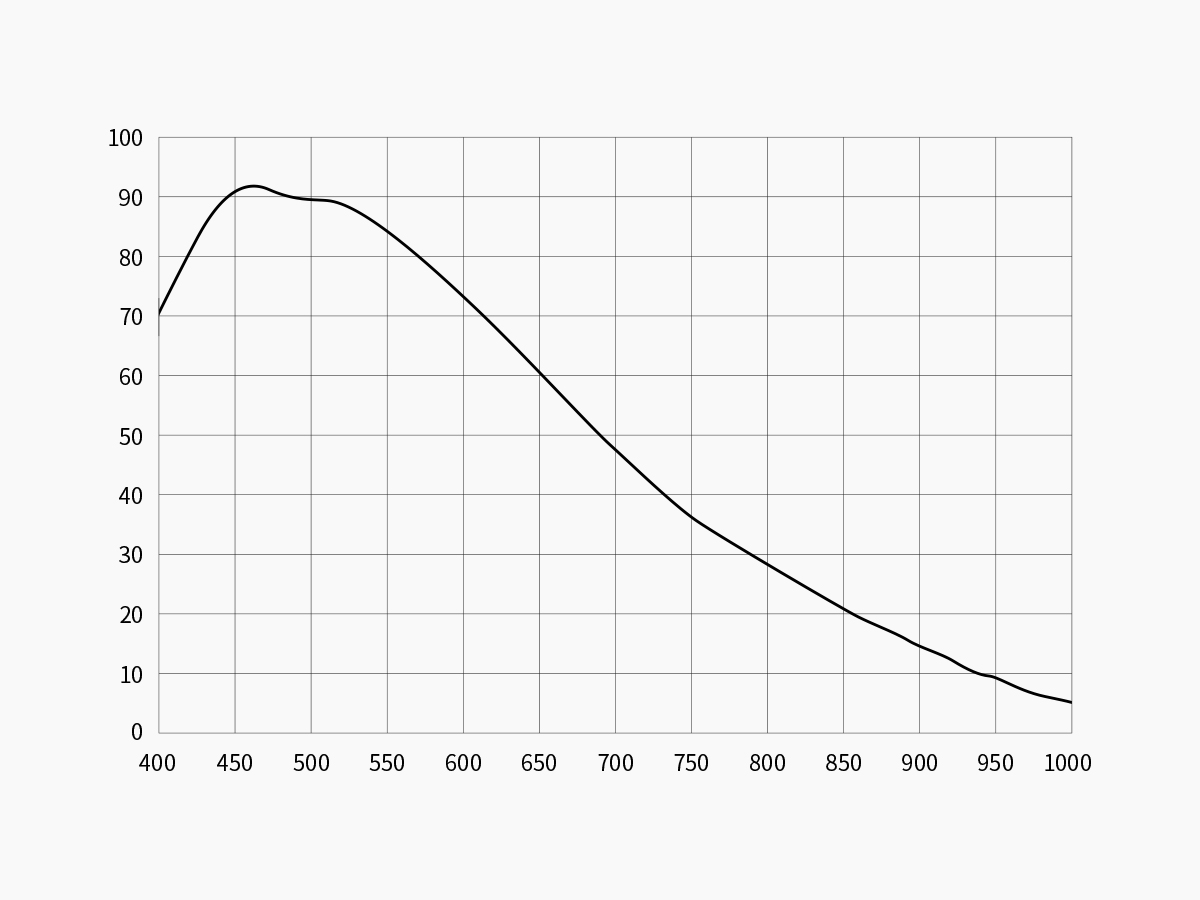
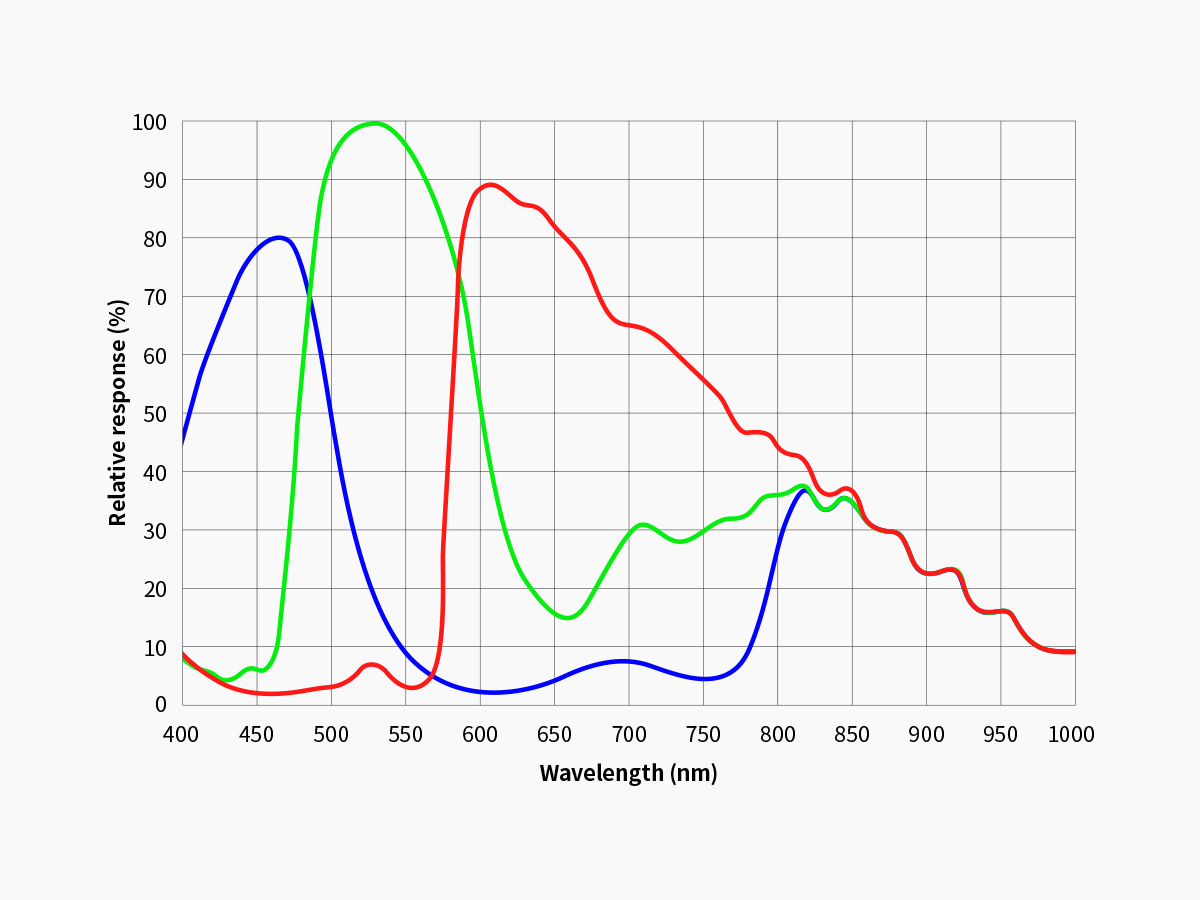
The QE peak value of the ASI2600MM Pro camera is 91%.
The QE peak value of the ASI2600MC Pro camera is 80%.
Ultra-low dark current
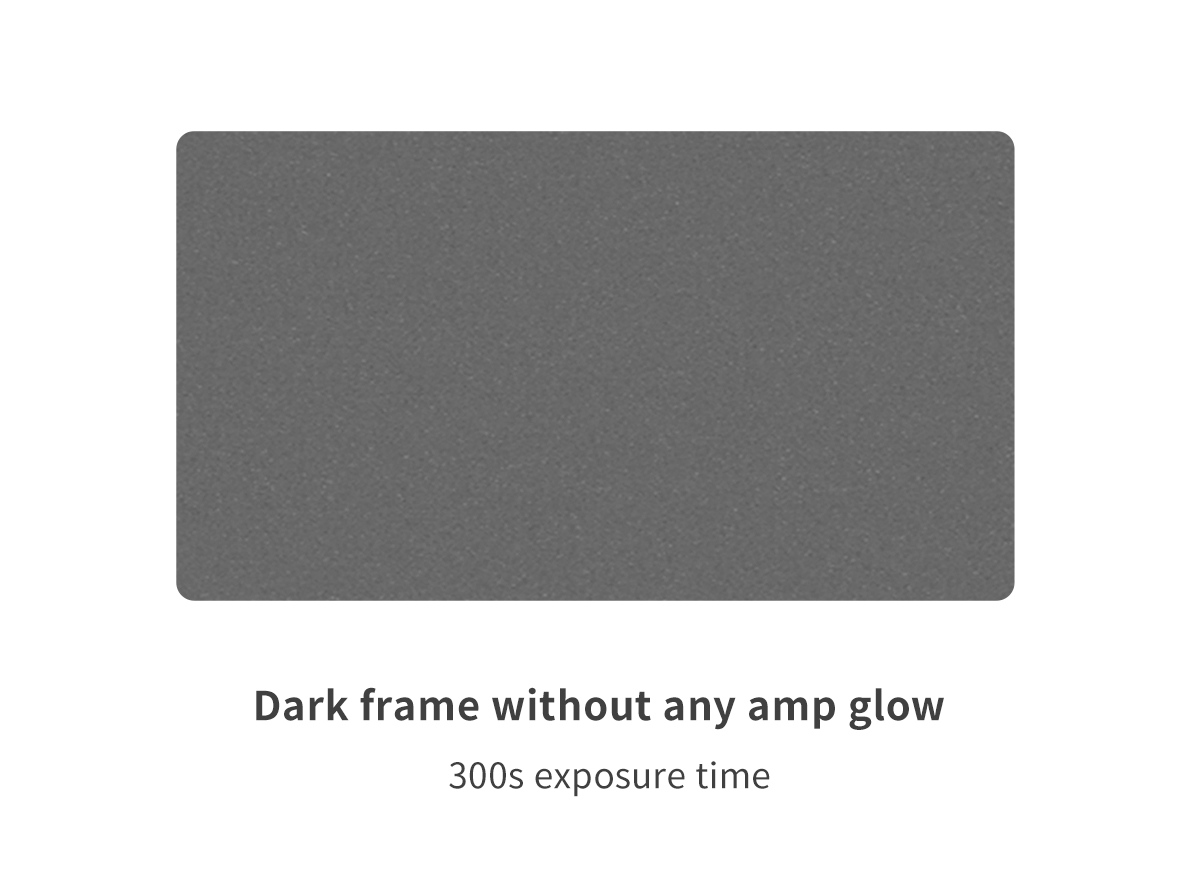
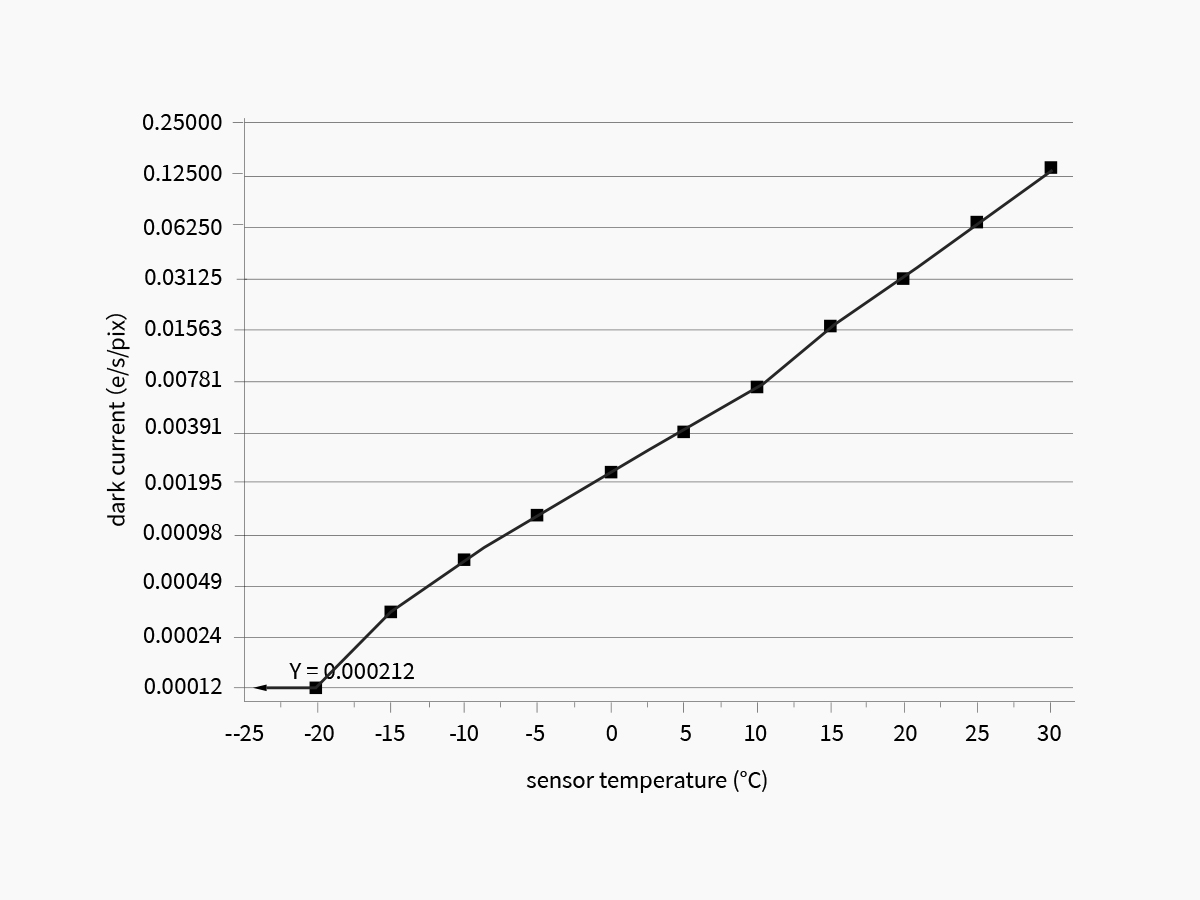
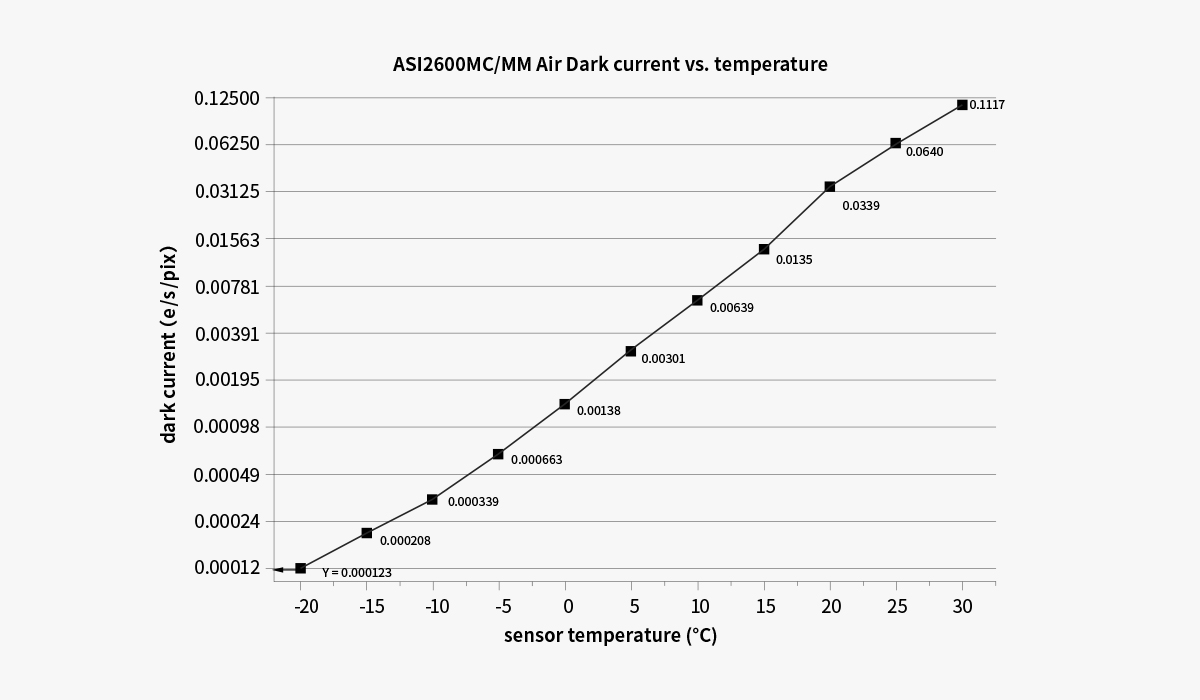
The ASI2600MM/MC Pro adopts advanced dark current suppression technology. At a cooling temperature of 0 °C, the dark current is only 0.0022e⁻/s/pix, which means that even with a 5-minute (300s) exposure, the total dark current noise is just 0.7e⁻—lower than the readout noise. At –20 °C, the dark current drops further to 0.00012e⁻/s/pix, making it virtually negligible.
The ZWO ASI2600MC Pro uses Sony’s latest back-illuminated IMX571 APS-C format native 16-bit ADC sensor. It has an ultra-high 14 stops dynamic range, ultra-low 1.0e readout noise and an innovative breakthrough resulting in zero amp-glow. It is a camera born from the appeal of astrophotography lovers.
The ASI2600MC Pro has excellent performance with a dynamic range of up to 14stops. When the gain value is 100, the magical HCG high gain mode is turned on, the readout noise is greatly reduced, and the dynamic range is basically unchanged. The camera comes with a anti-dew heater which completely fits the protective window and will heat it to avoid any dew problems. The anti-dew heater power requirement is around 5W and the heater can be turned off in software to save power.
All Pro cameras (with cooler) need to be connected to an external 11-15v power supply to work correctly.
Even when the cooler is not being used the power supply must be used for the camera to be recognized.
The body weighs just 0.7 kg(1.54 lbs), yet delivers outstanding image performance.
APS-C Sony IMX571 Sensor
The ASI2600MM/MC Pro is equipped with the APS-C format Sony IMX571 sensor, measuring 23.5mm × 15.7mm with a 28.3mm diagonal. It delivers an outstanding resolution of 6248 × 4176 pixels, making it a true 26-megapixel powerhouse. Each 3.76 μm pixel offers an impressive full-well capacity of 73ke⁻, ensuring exceptional dynamic range and image quality.
Native 16bit ADC
The advanced CMOS architecture of the ASI2600 enables a true 14-stop dynamic range. This ensures exceptionally smooth tonal transitions, richer color gradients, and the ability to capture both the faintest details and the brightest highlights within a single frame.
Zero Amp Glow
As the ASI2600MM/MC Pro uses zero amp glow circuitry, you won’t have to worry about amp glow even when using high gain, long exposure imaging.
Anti-dew
The ASI2600MM/MC uses a built-in polyimide heater bonded to the protective window, preventing dew and frost for clear, reliable imaging all night long.
USB 3.0 & 512MB DDR3 Memory
The ASI2600MM/MC Pro incorporates a high-speed USB 3.0 interface paired with a dedicated 512MB DDR3 memory buffer. This architecture minimizes data loss and latency, delivering fast, stable, and secure transmission even during long exposures and continuous high-resolution capture.
Sensor Tilt Adjustment
The camera incorporates a tilt plate with three sets of adjustment screws. In combination with the three mounting screws, they enable precise fine-tuning of the sensor plane for accurate alignment with the telescope’s optical axis, ensuring a flat imaging field and consistent star shapes across the entire frame.
Two-stage TEC cooling
Thanks to its two-stage TEC cooling system, the ASI2600MM/MC Pro can reduce the CMOS sensor temperature by 30°C–35°C below ambient, significantly lowering dark current and sensor noise even during long exposures.
The ΔT of 35°C is measured at 30℃ ambient temperature.
Camera Performance
The ASI2600MM/MC Pro achieves a dynamic range of up to 14 stops. When the gain setting reaches 100, the HCG (High Conversion Gain) mode is automatically enabled, which substantially reduces readout noise while preserving dynamic range. For optimal deep-sky imaging performance, a gain setting of 0 or 100 is recommended.
QE value
The QE peak value of the ASI2600MM Pro camera is 91%.
The QE peak value of the ASI2600MC Pro camera is 80%.
Ultra-low dark current
The ASI2600MM/MC Pro adopts advanced dark current suppression technology. At a cooling temperature of 0 °C, the dark current is only 0.0022e⁻/s/pix, which means that even with a 5-minute (300s) exposure, the total dark current noise is just 0.7e⁻—lower than the readout noise. At –20 °C, the dark current drops further to 0.00012e⁻/s/pix, making it virtually negligible.
The main sensor IMX571 features an APS-C format and 26MP total pixels. The size is 23.5mm in width x 15.7mm in height, and the diagonal is 28.3mm. The 3.76um x 3.76um small pixel size accommodates an impressive full depth of 50ke. With the new hardware technology, it is even extended to 73ke.
Guide Sensor
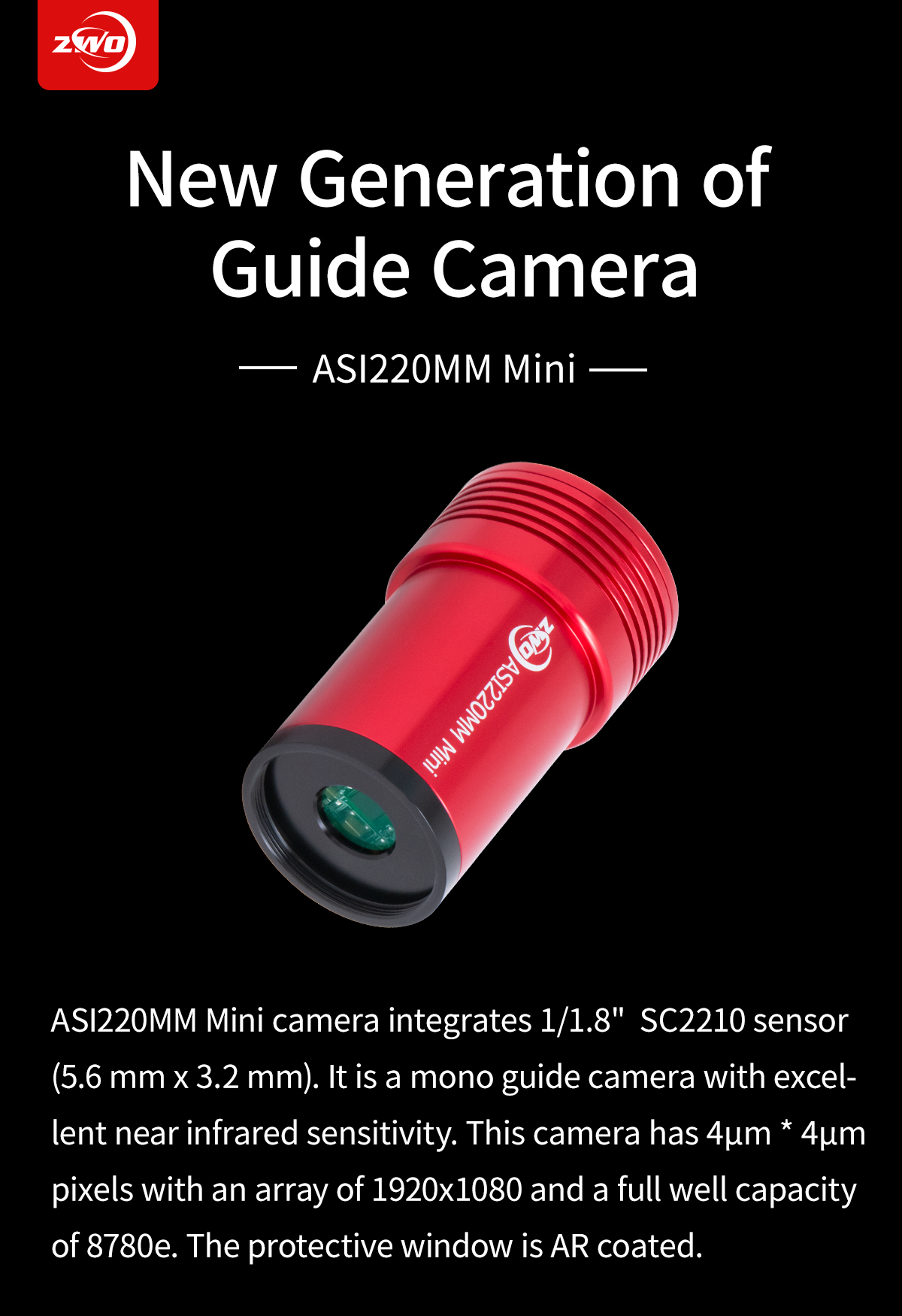
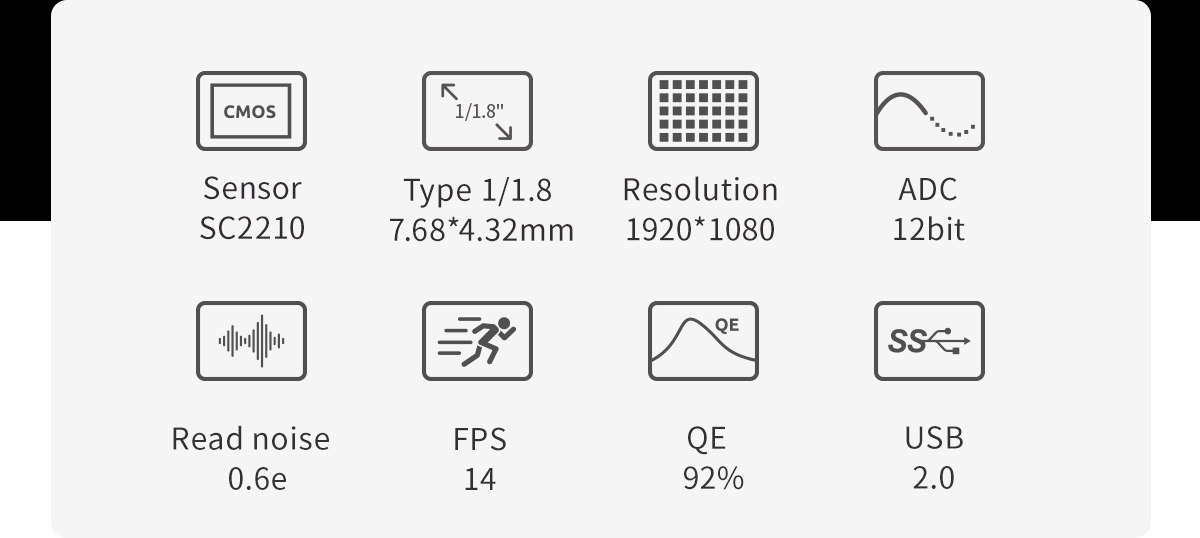
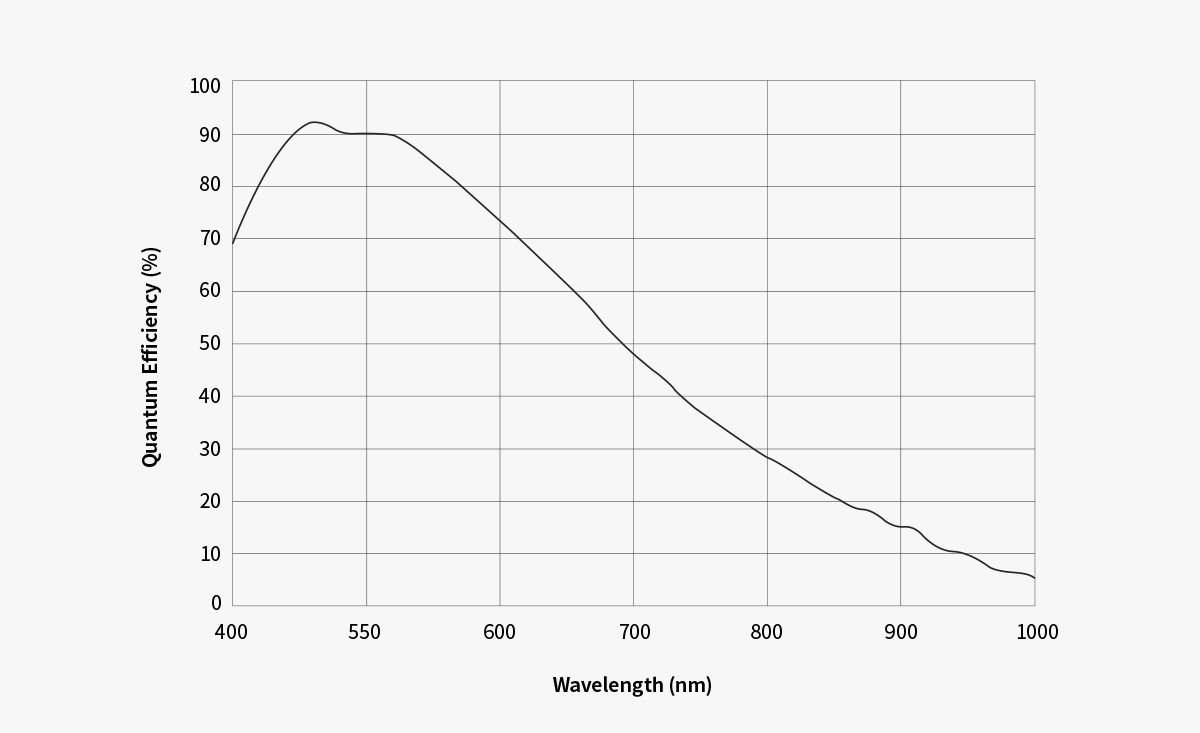
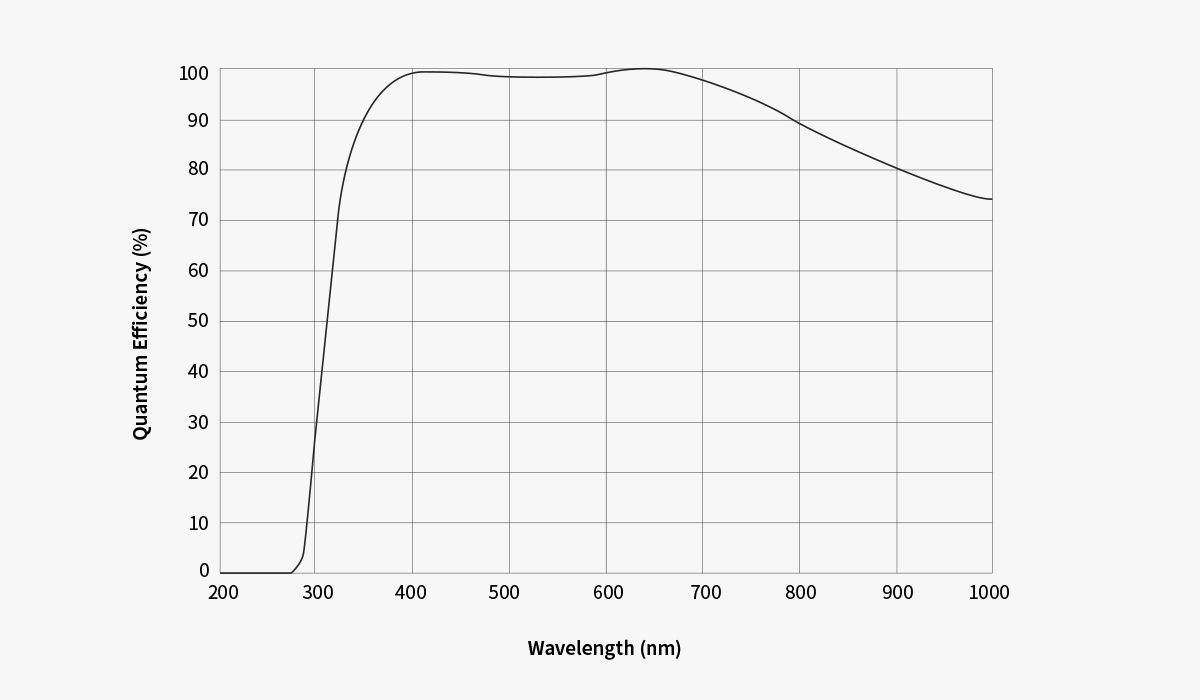
The SC2210 sensor taken from the ASI220MM Mini camera features very high sensitivity. The QE peak value reaches 92% at 500nm. The read noise is as low as 0.6e. As the new generation of guide sensor, it has achieved great results in guiding, proved by hundreds of astrophotographers.
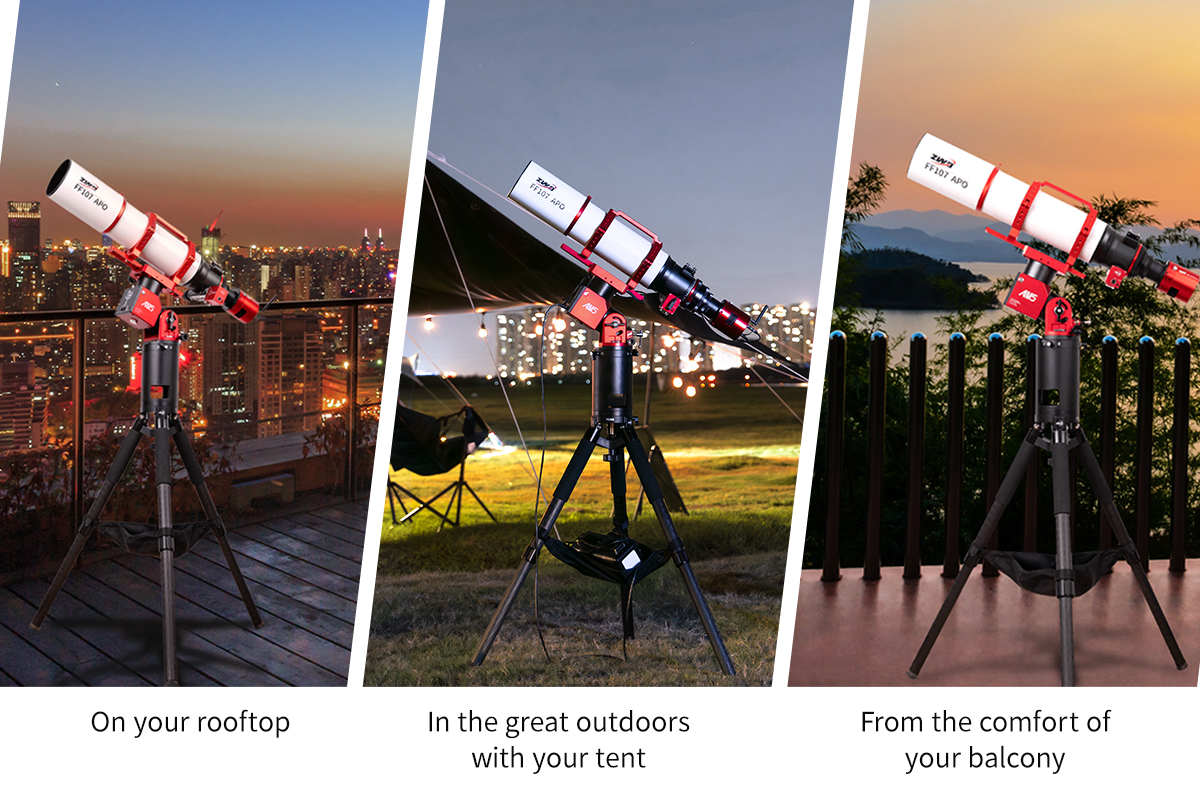
Enjoy the Beauty of the Night Sky Anywhere
Start Your Astrophotography Journey with Great Convenience
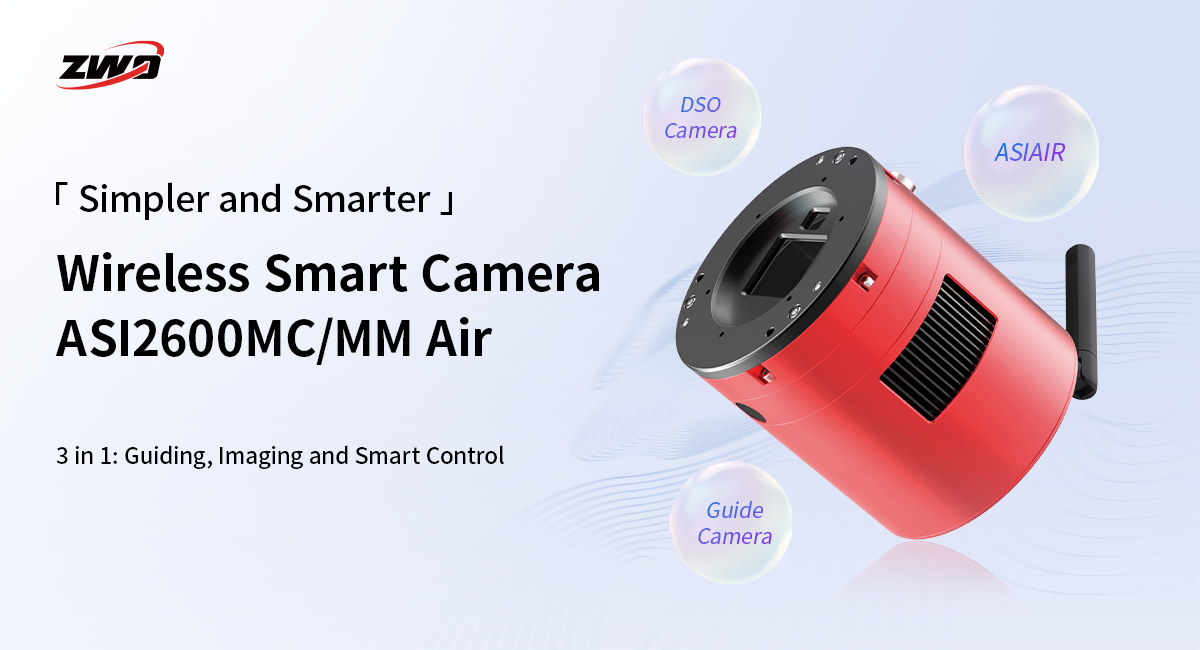
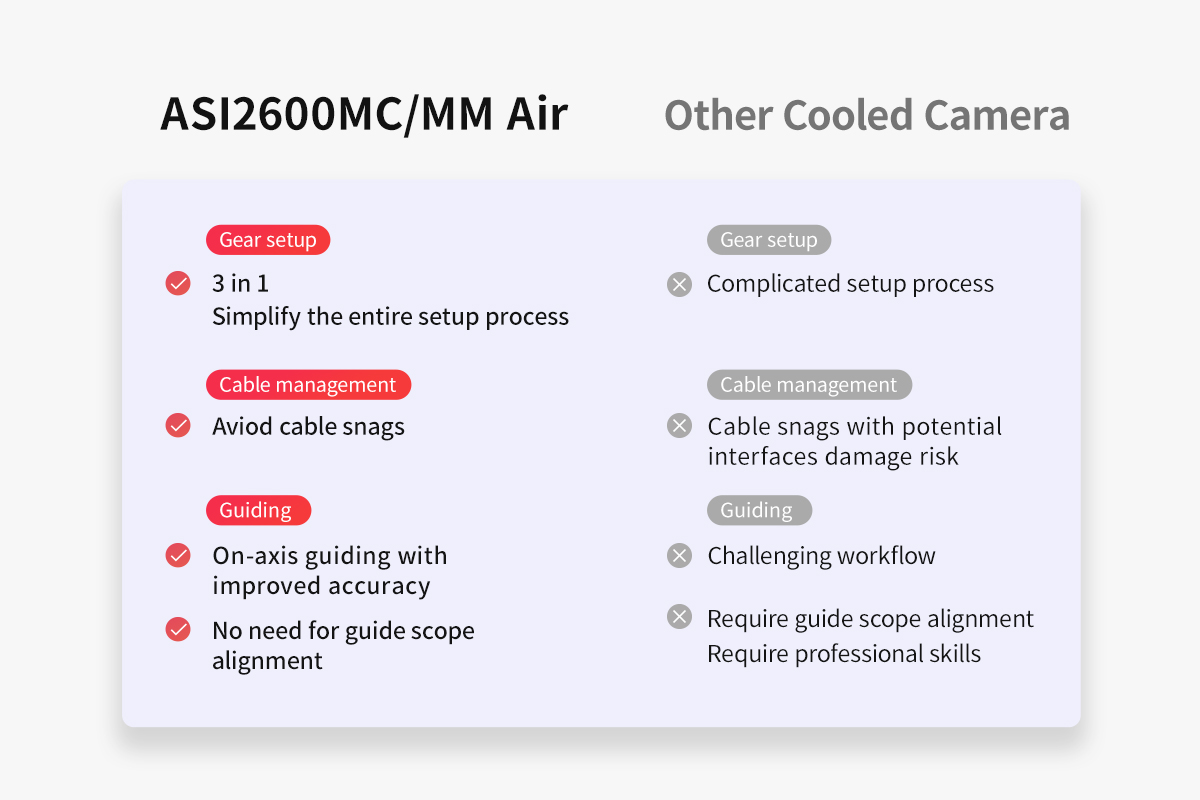
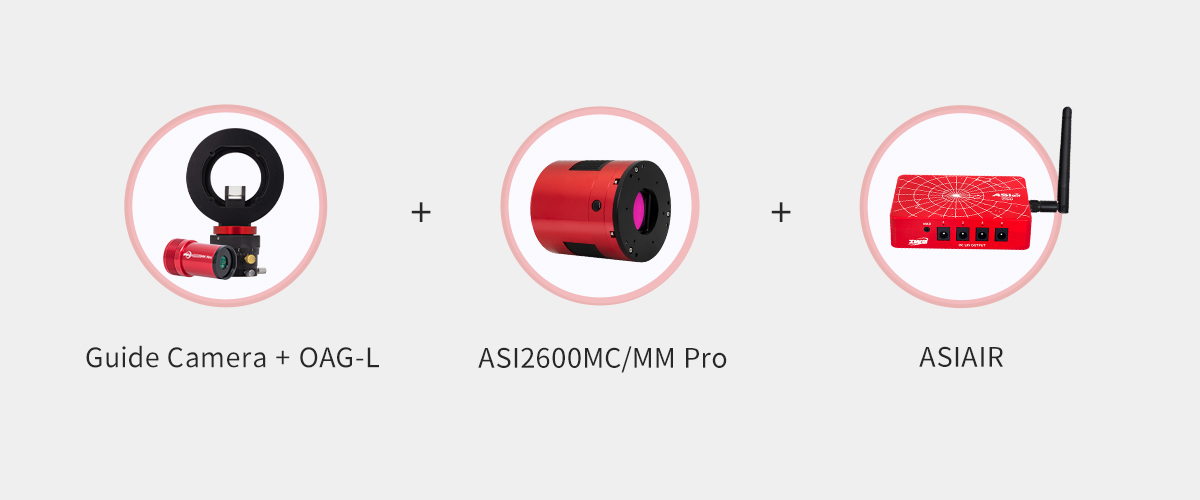
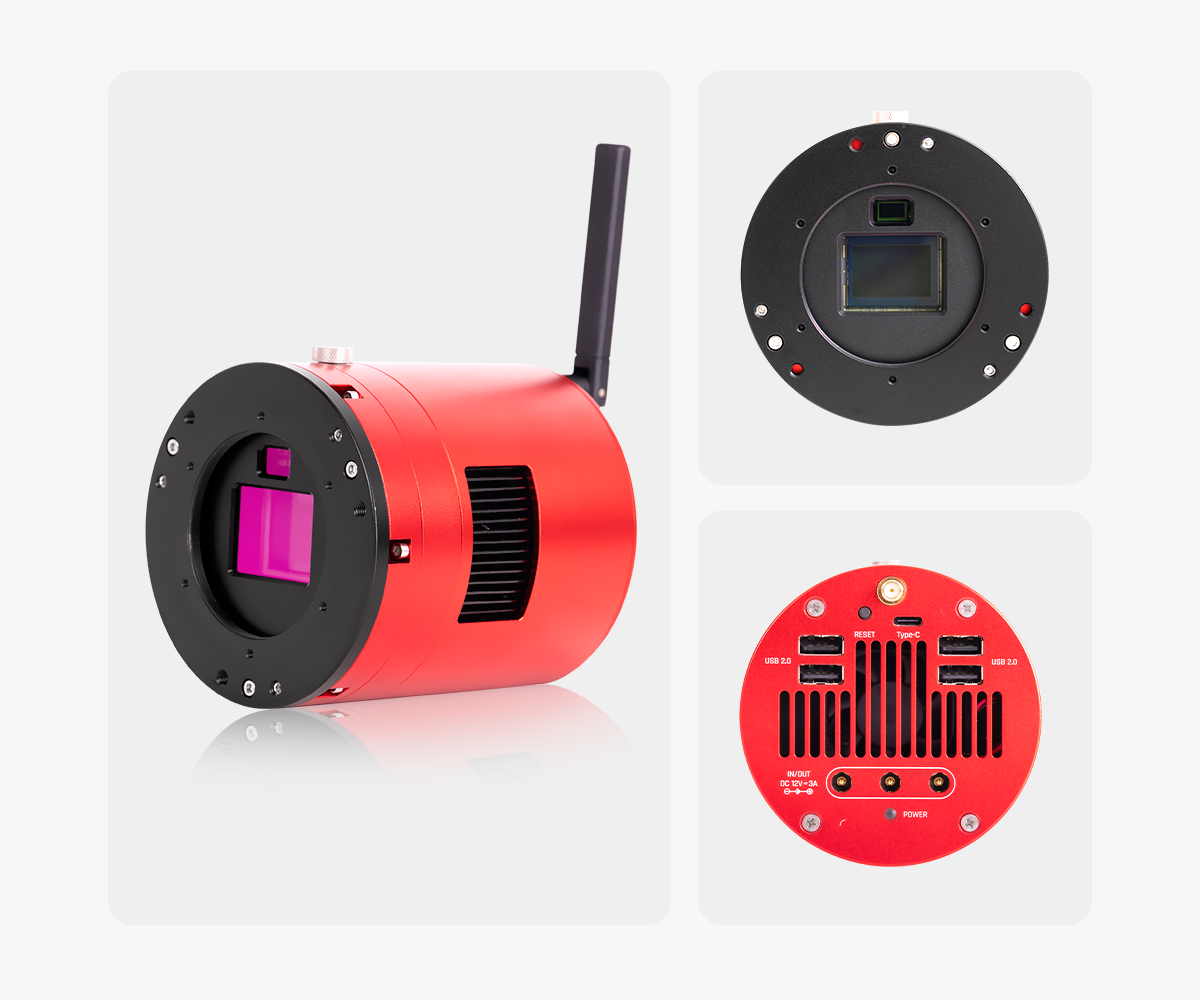
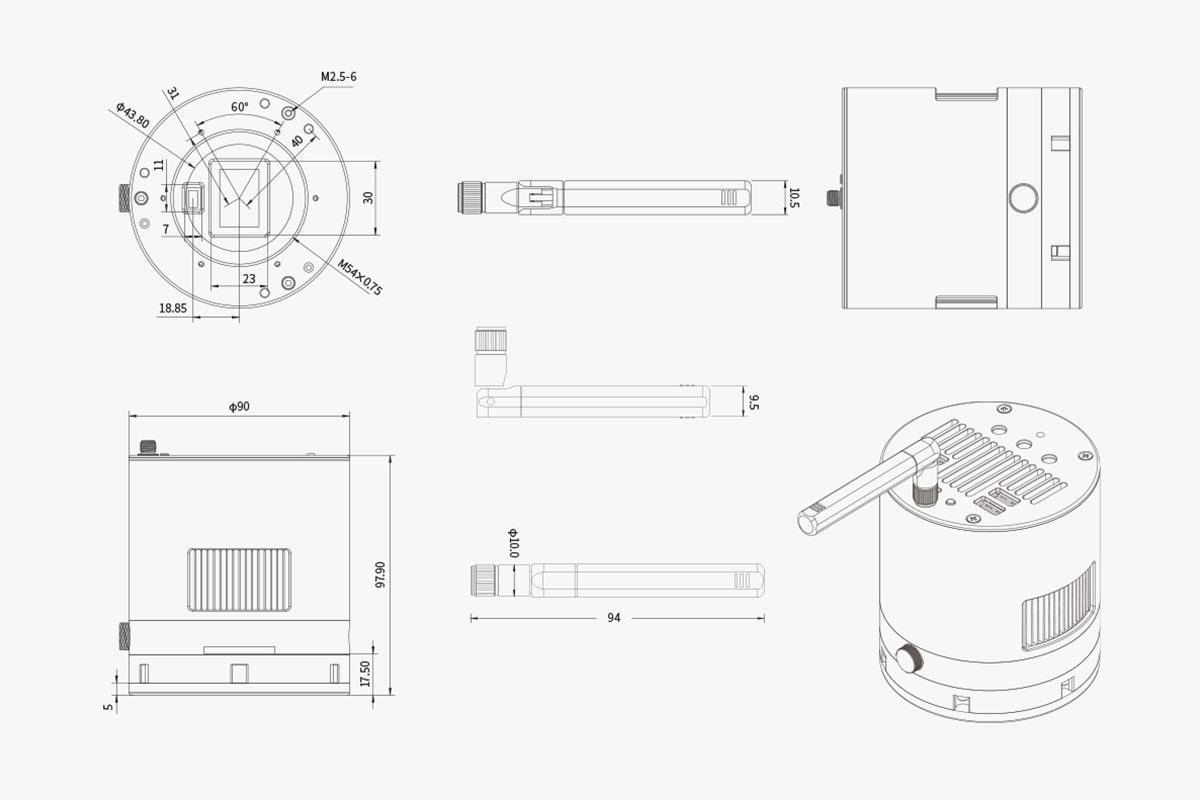
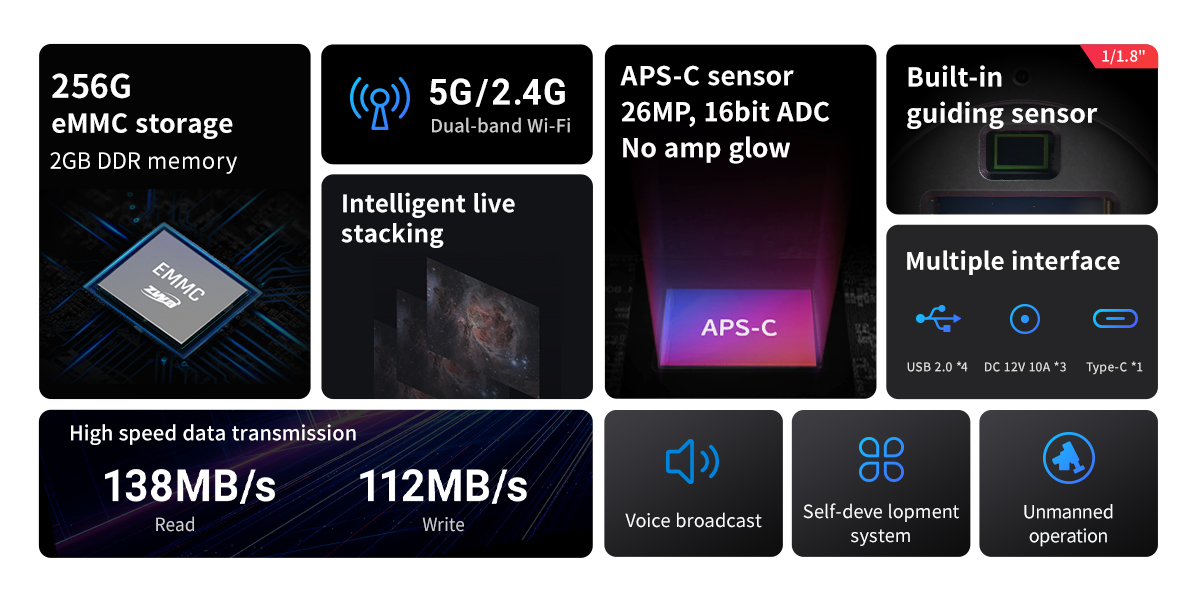
The ASI2600MC/MM Air combines guiding, imaging, and smart control into one compact, lightweight device. Say goodbye to complex setups and enjoy a seamless, hassle-free astrophotography experience.
Effortlessly Connect Mutiple Devices
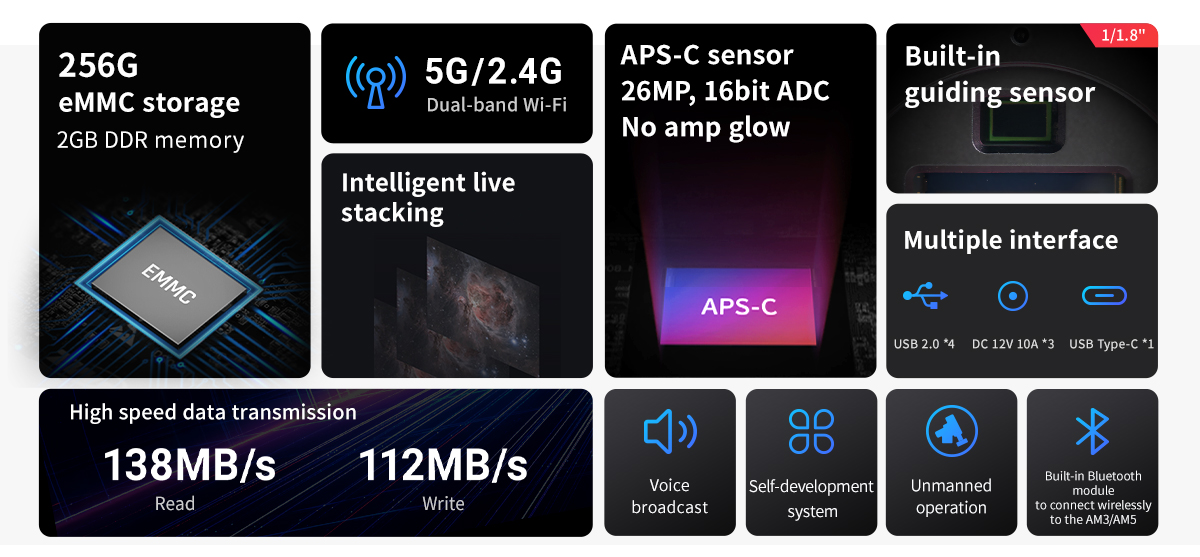
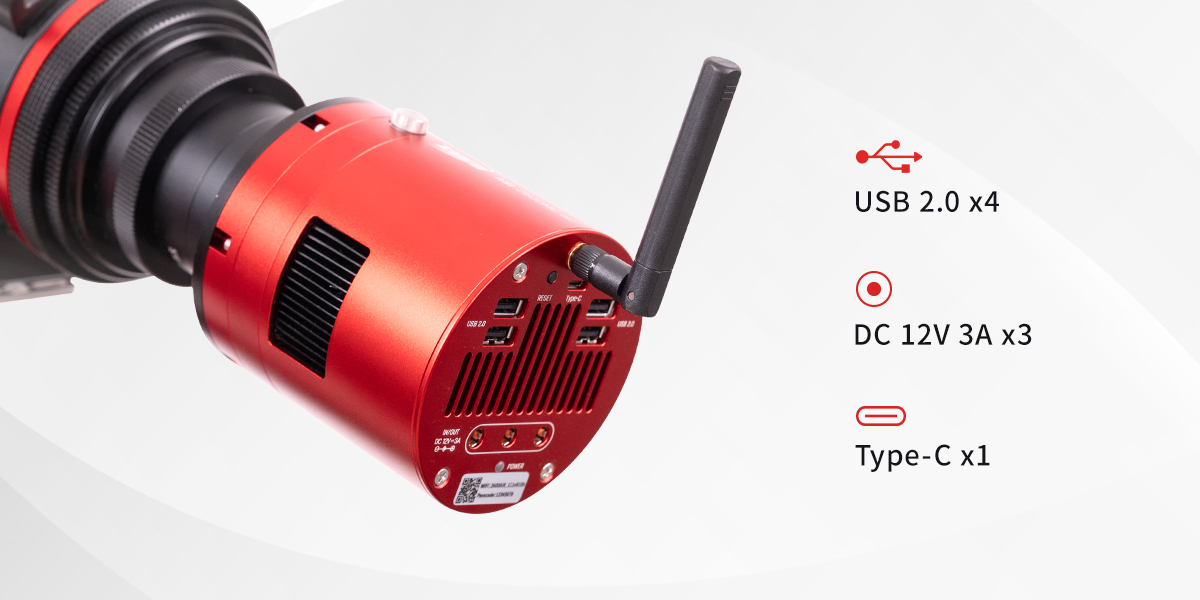
4x USB2.0, 3x DC12V 10A, 1x USB Type-C USB 2.0 ports for your focuser, filter wheel, and mount; DC 12V 10A input/output ports for reliable power; and USB Type-C port for fast file transfers—you can focus on capturing stunning images without worrying about connectivity issues.
Shoot with Confidence: Ample Storage and Stability
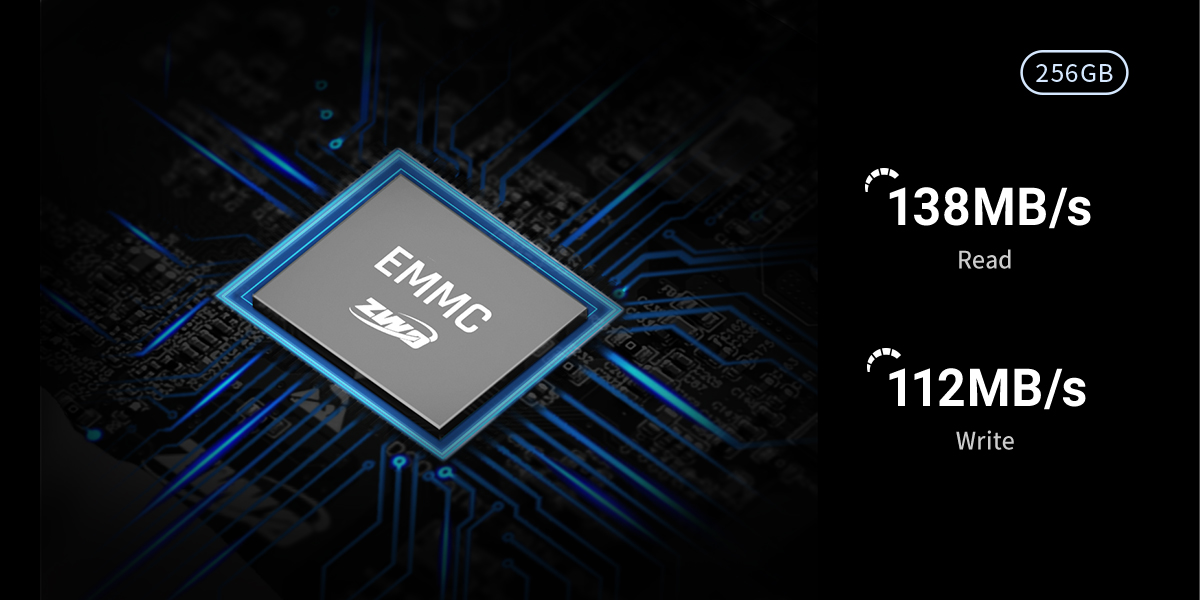
With a massive 256GB eMMC storage, the ASI2600MC Air allows you to capture multiple targets with ease. Rigorously tested with over 300 benchmarks, it ensures system stability. Plus, the USB 2.0 ports support up to 1TB external storage, giving you plenty of room for all your astrophotography needs.
Dive into the Rich Details of the Celestial Targets
In expanded mode, the full well capacity of this camera reaches 73Ke, which is 1.46 times of that of the IMX571 sensor (51ke), making long-exposure shots less prone to overexposure. The large full well capacity and high dynamic range make capturing both light and dark areas with stunning clarity and detail possible. Witness the miracle details and colors of targets like never before!
Dual-Band Wi-Fi for Stable Singal
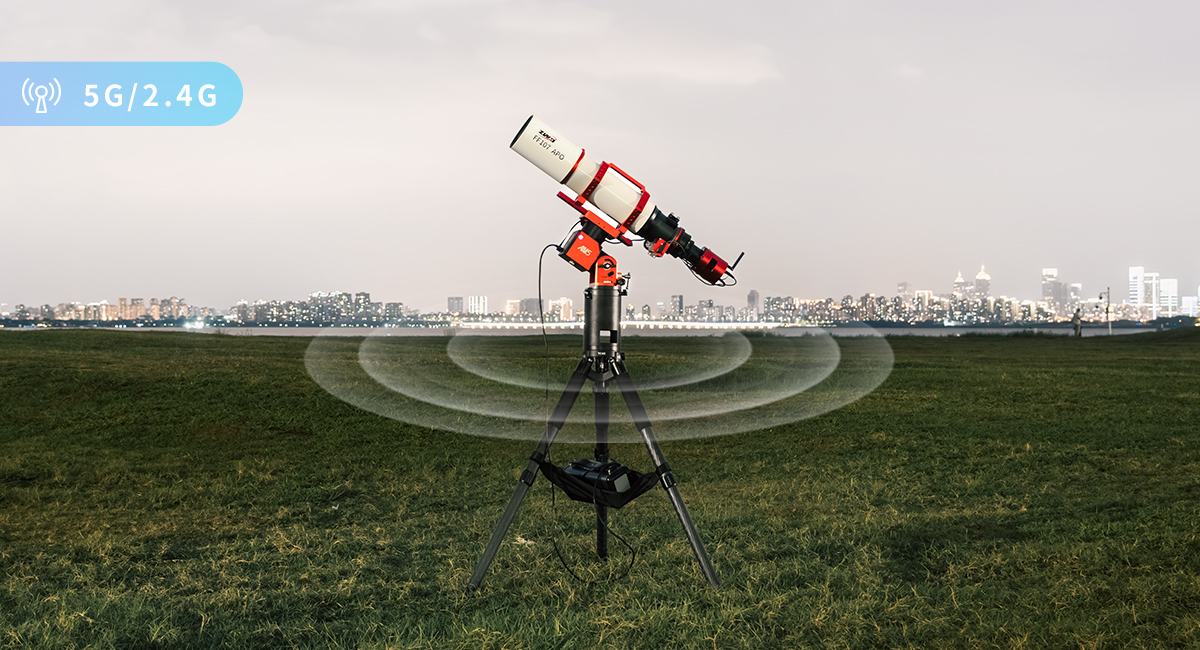
Experience unparalleled connectivity with our enhanced external dual-band antenna, supporting both 2.4G and 5G frequencies and offering stable and smooth usage within 20 meters.
Cross-Platform Device Control
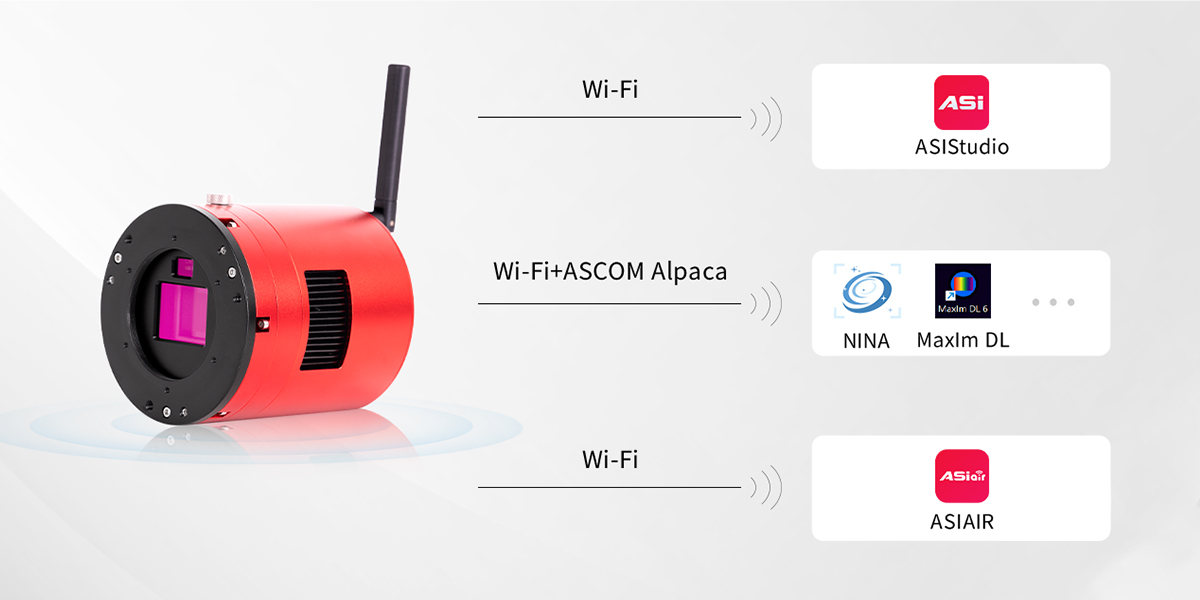
Except from ASIAIR App, ASI2600MC Air can also wirelessly connect to ZWO’s proprietary PC control software, ASIStudio, and also other 3rd-party PC software. 3rd-party software can be controlled through ASCOM extended protocol Alpaca (requires ASCOM Platform version V6.6 or higher).
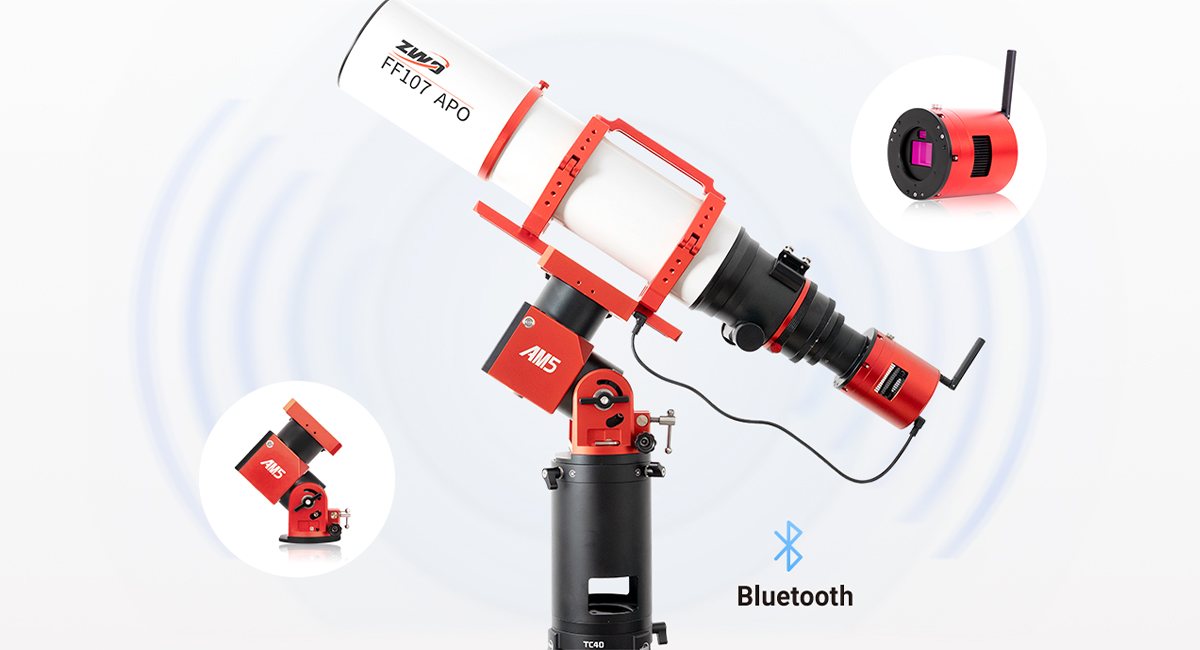
Bluetooth Connection Supported
Nice and Neat Wiring with AM3/AM5
Get Fully Control of Your Entire Rig at Your Fingertips
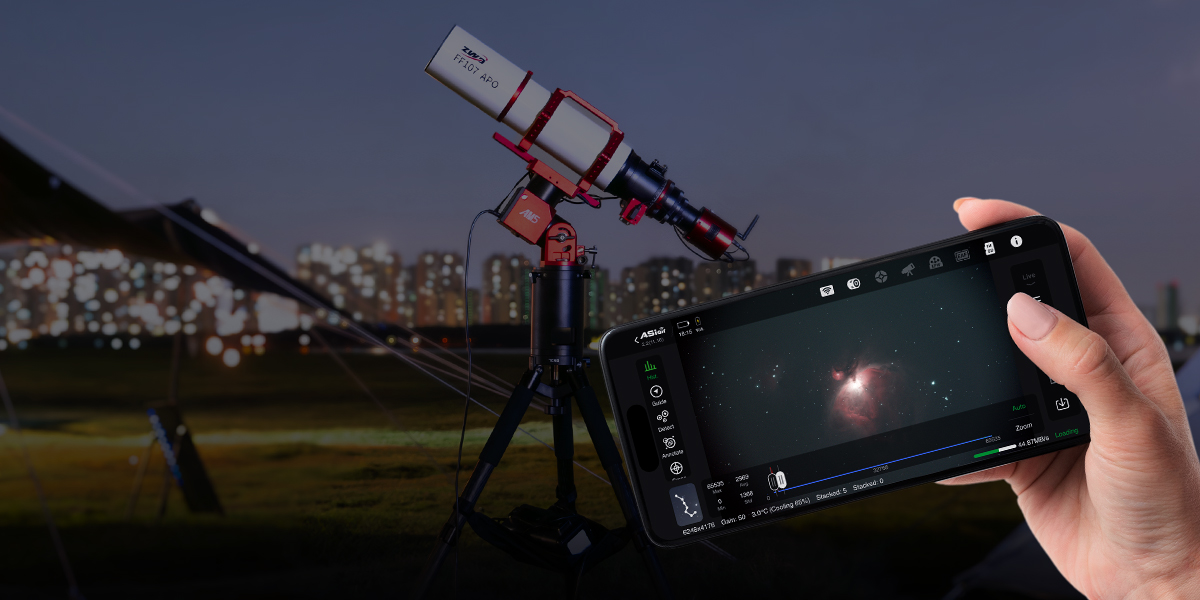
With the ASIAIR smart app, you can easily control guiding, imaging, your mount, and electronic focuser—all from your phone. It supports multiple imaging modes, making it easy for even beginners to quickly learn and capture professional-quality images.
Instant Post-Processing and Sharing
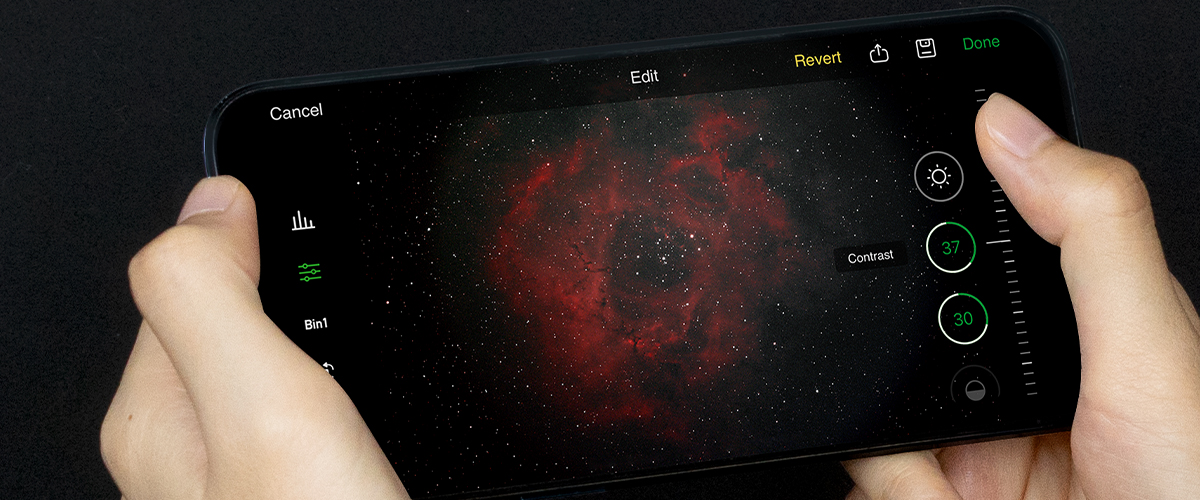
Live stack is supported during your imaging session. You may also make adjustments to brightness, contrast and others on the final image. Instantly share your masterpieces on social media platforms and astronomy communities, making your work stand out.
Go Further With ZWO’s Self-Developed System
Powered by ZWO’s patented technologies, our system ensures stable astrophotography performance. Continuous App OTA updates keep your device up-to-date with the latest features, enhancing your user experience and expanding your capabilities.
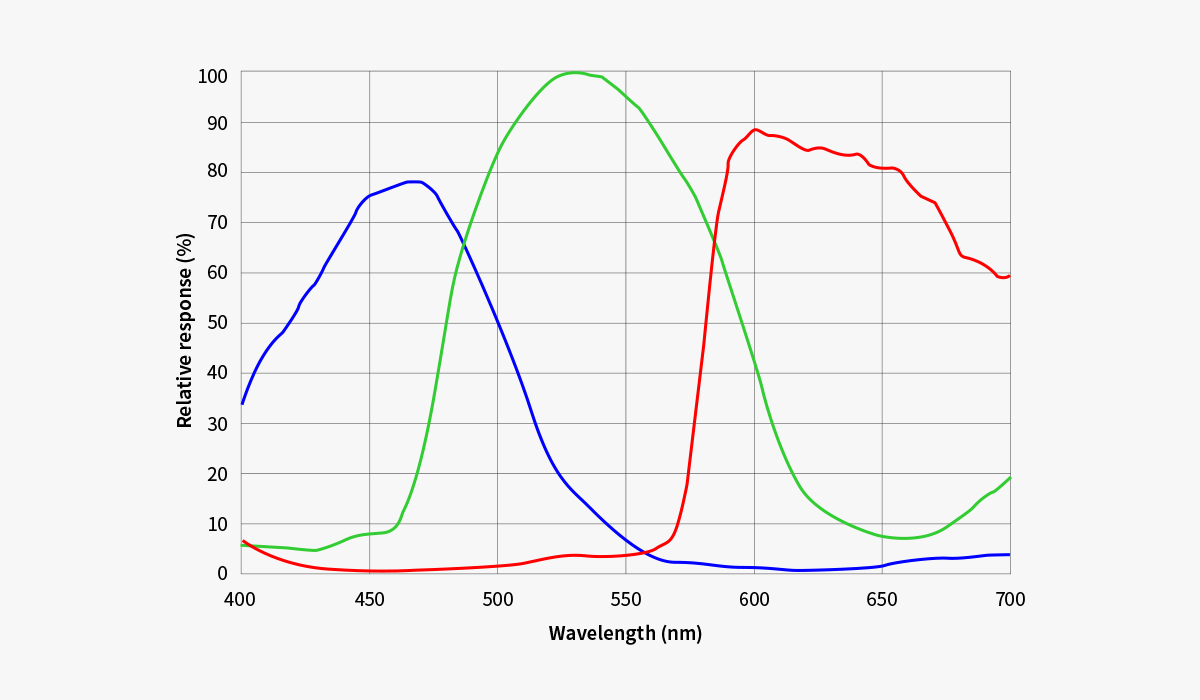
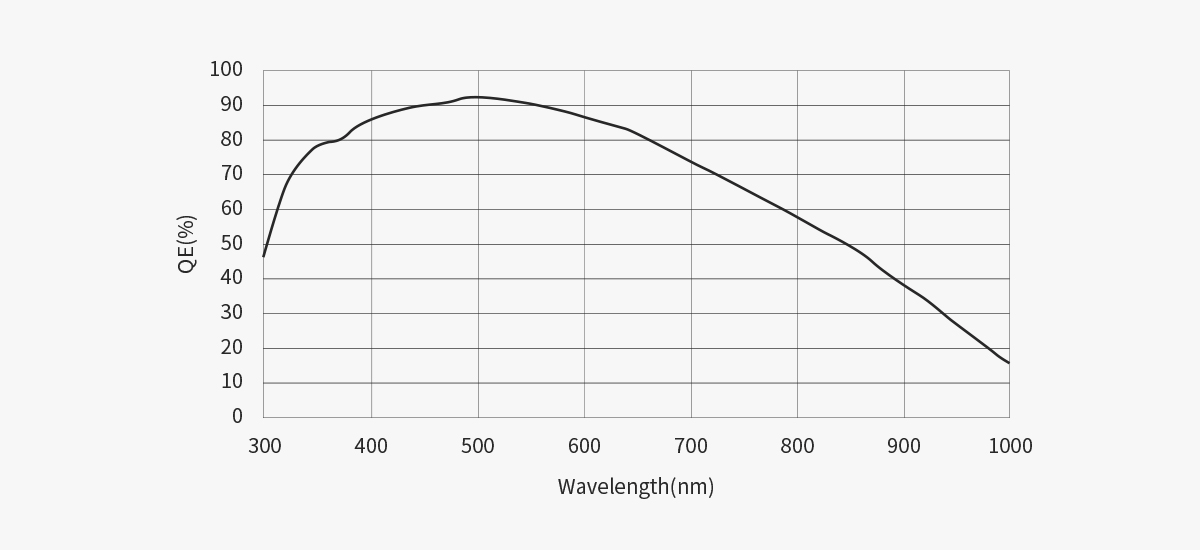
Quantum efficiency(QE) -Main sensor
The QE peak value of ASI2600MC Air’s main sensor is estimated to be over 80%.
The QE peak value of the ASI2600MM Air’s main sensor is approximately 91%.
Quantum efficiency(QE) – Guide sensor
Dark Current
Power Consumption IR-Cut coating for OSC camera
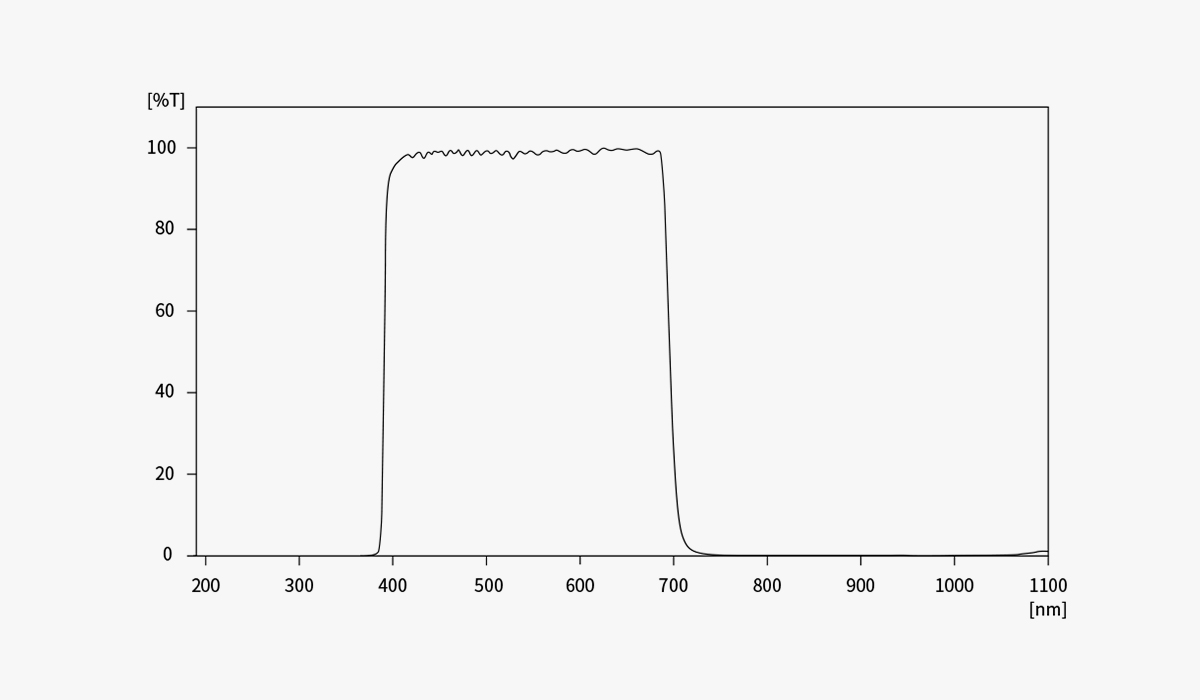
The ASI2600MC Air camera is equipped with a UV-IR Cut filter (infrared cutoff filter) in front of the sensor, which serves as a protective window.
The ASI2600MM Air camera is equipped with an AR filter (anti-reflective filter) in front of the sensor, which serves as a protective window.
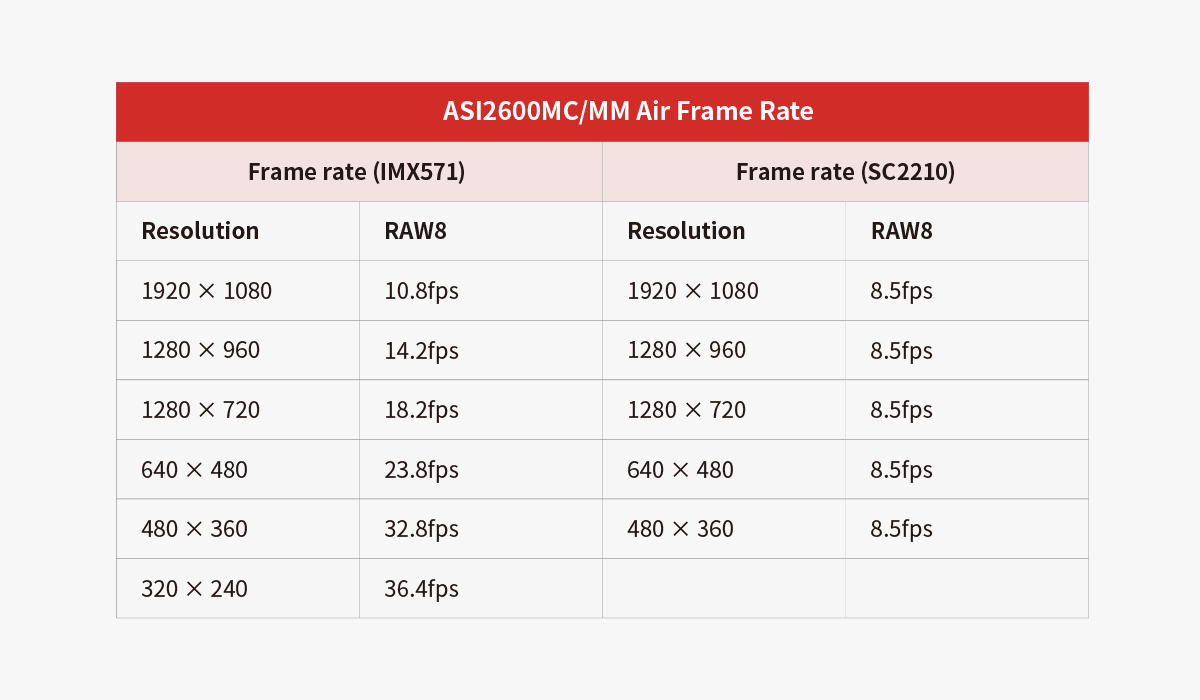
Frame Rate
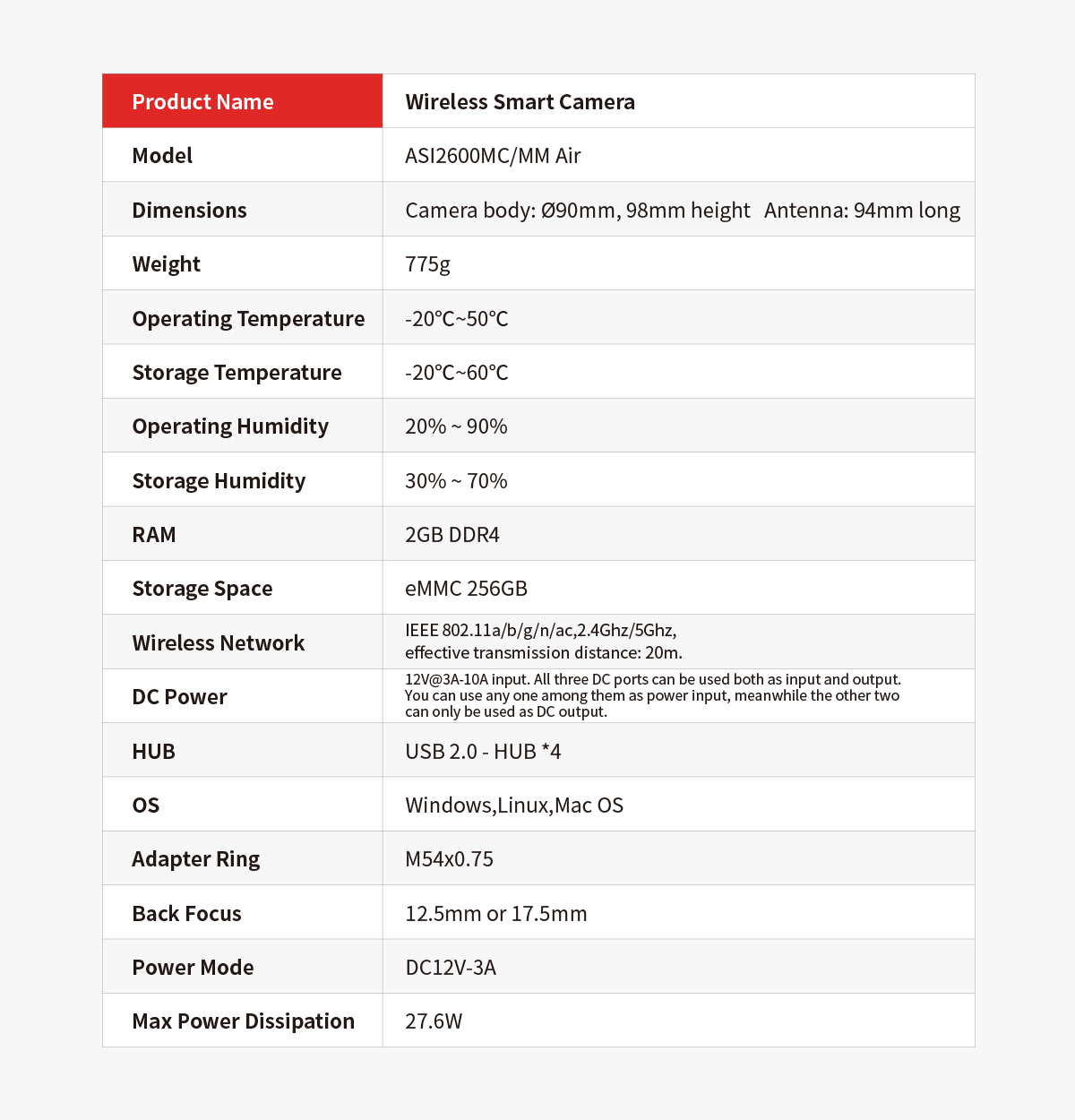
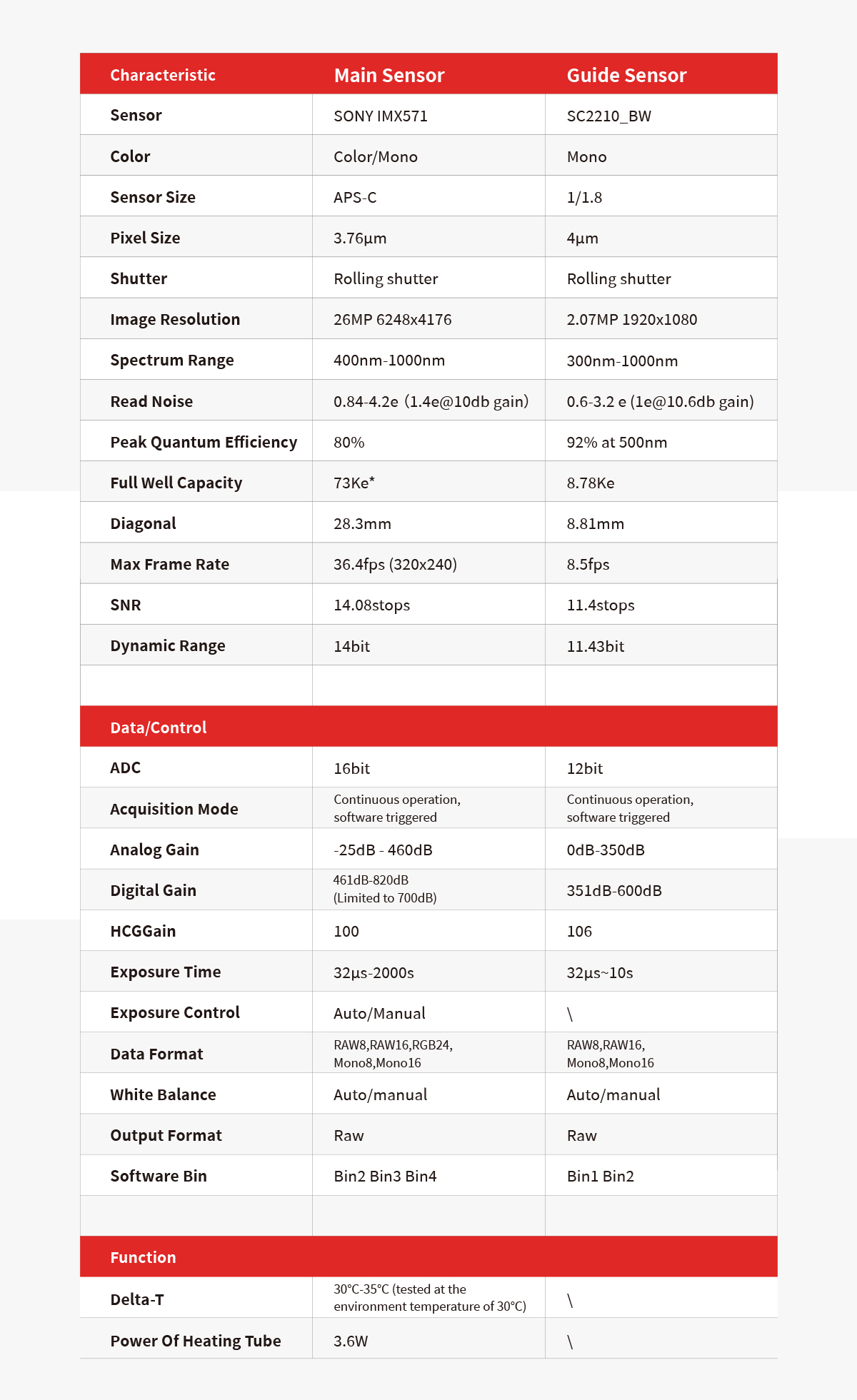
Camera Specification
Image Circle Compatibility Reference
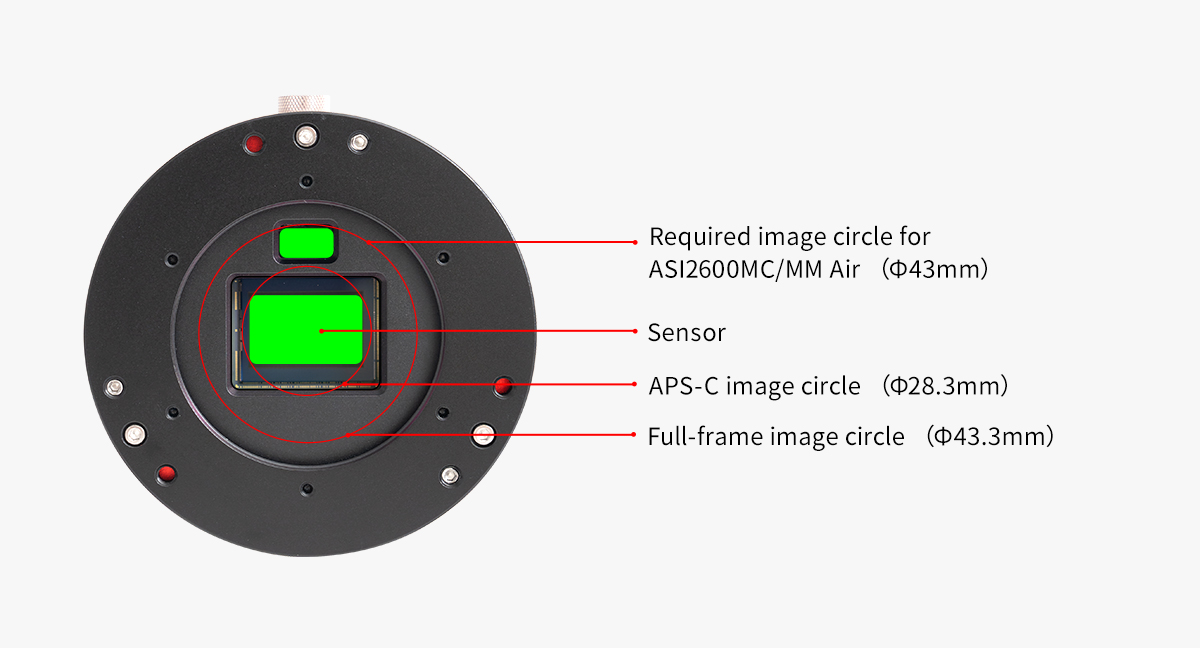
Please refer to the diagram below to understand how ASI2600MC/MM Air cameras match with various telescope image circles.
ZWO Air cameras are compatible with telescopes that support APS-C or larger image formats. Note: When using a telescope with an APS-C image circle, you may notice slight distortion in the guide star. If you’re looking for more accurate and stable guiding performance, we recommend using a telescope with a full-frame or larger image circle.
The ASI2600MM Duo combines imaging and guiding sensors in one camera. The main sensor is APS-C format IMX571 made by Sony. With a native 16-bit ADC, 14 stops dynamic range and a impressive full well capacity of 73ke it is one of the best cameras on the market. This versatile camera only needs one USB cable for guiding and imaging, preventing possible cable snags by reducing the amount of cables.
The guide sensor is the Type 1/1.8 SC2210 with excellent NIR sensitivity. The sensor size is 7.68mm x 4.32mm. It has 4umx4um pixels with an array of 1920×1080 and a full depth of 8780e.
The body weighs just 0.7 kg(1.54 lbs), yet delivers outstanding image performance.
APS-C Sony IMX571 Sensor
The ASI2600MM/MC Pro is equipped with the APS-C format Sony IMX571 sensor, measuring 23.5mm × 15.7mm with a 28.3mm diagonal. It delivers an outstanding resolution of 6248 × 4176 pixels, making it a true 26-megapixel powerhouse. Each 3.76 μm pixel offers an impressive full-well capacity of 73ke⁻, ensuring exceptional dynamic range and image quality.
Native 16bit ADC
The advanced CMOS architecture of the ASI2600 enables a true 14-stop dynamic range. This ensures exceptionally smooth tonal transitions, richer color gradients, and the ability to capture both the faintest details and the brightest highlights within a single frame.
Zero Amp Glow
As the ASI2600MM/MC Pro uses zero amp glow circuitry, you won’t have to worry about amp glow even when using high gain, long exposure imaging.
Anti-dew
The ASI2600MM/MC uses a built-in polyimide heater bonded to the protective window, preventing dew and frost for clear, reliable imaging all night long.
USB 3.0 & 512MB DDR3 Memory
The ASI2600MM/MC Pro incorporates a high-speed USB 3.0 interface paired with a dedicated 512MB DDR3 memory buffer. This architecture minimizes data loss and latency, delivering fast, stable, and secure transmission even during long exposures and continuous high-resolution capture.
Sensor Tilt Adjustment
The camera incorporates a tilt plate with three sets of adjustment screws. In combination with the three mounting screws, they enable precise fine-tuning of the sensor plane for accurate alignment with the telescope’s optical axis, ensuring a flat imaging field and consistent star shapes across the entire frame.
Two-stage TEC cooling
Thanks to its two-stage TEC cooling system, the ASI2600MM/MC Pro can reduce the CMOS sensor temperature by 30°C–35°C below ambient, significantly lowering dark current and sensor noise even during long exposures.
The ΔT of 35°C is measured at 30℃ ambient temperature.
Camera Performance
The ASI2600MM/MC Pro achieves a dynamic range of up to 14 stops. When the gain setting reaches 100, the HCG (High Conversion Gain) mode is automatically enabled, which substantially reduces readout noise while preserving dynamic range. For optimal deep-sky imaging performance, a gain setting of 0 or 100 is recommended.
QE value
The QE peak value of the ASI2600MM Pro camera is 91%.
The QE peak value of the ASI2600MC Pro camera is 80%.
Ultra-low dark current
The ASI2600MM/MC Pro adopts advanced dark current suppression technology. At a cooling temperature of 0 °C, the dark current is only 0.0022e⁻/s/pix, which means that even with a 5-minute (300s) exposure, the total dark current noise is just 0.7e⁻—lower than the readout noise. At –20 °C, the dark current drops further to 0.00012e⁻/s/pix, making it virtually negligible.
ZWO ASI290MM features a Sony IMX290 sensor. It is highly recommended for autoguiding and planetary astrophotography. ASI290MM offers very good performance for astrophotography. Low read noise, high dynamic range, QE peak about 80%, AR protective window and much more.